Too Much Atorvastatin: Extra Doses, Symptoms and What to Record
An extra dose needs context
A single accidental extra statin dose usually causes little concern; large amounts or repeatedly excessive doses need medical attention. That reassurance cannot classify every exposure. Other medicines and the circumstances matter. 2
UK NHS guidance says an extra atorvastatin dose is unlikely to cause problems, while recommending prompt pharmacist advice after more than prescribed. These sources both support assessing the amount and circumstances rather than applying one universal emergency-room rule. 4 2
For a child, an unknown amount or an intentional exposure, seek immediate individual assessment. Say clearly if the amount is uncertain; do not delay the call while trying to reconstruct a perfect count.
Work out what was actually swallowed
“Two pills” is incomplete information. Find the name and milligrams on the packet, then separate the usual prescribed dose from the amount possibly swallowed. For arithmetic only, two 20-mg tablets total 40 mg; that calculation does not establish whether the exposure is safe.
This article centers on Lipitor tablets. Identify a liquid or combination product explicitly because its instructions and assessment may differ. Keep a list of prescription medicines, nonprescription products and supplements available. 3
If someone else manages the medicine, ask them to check the packet and dose log with you. Record a range when necessary: “one or two tablets” is more useful than an unjustified exact number. Note whether an extra dose happened once or on several days.
Make an incident record for the call
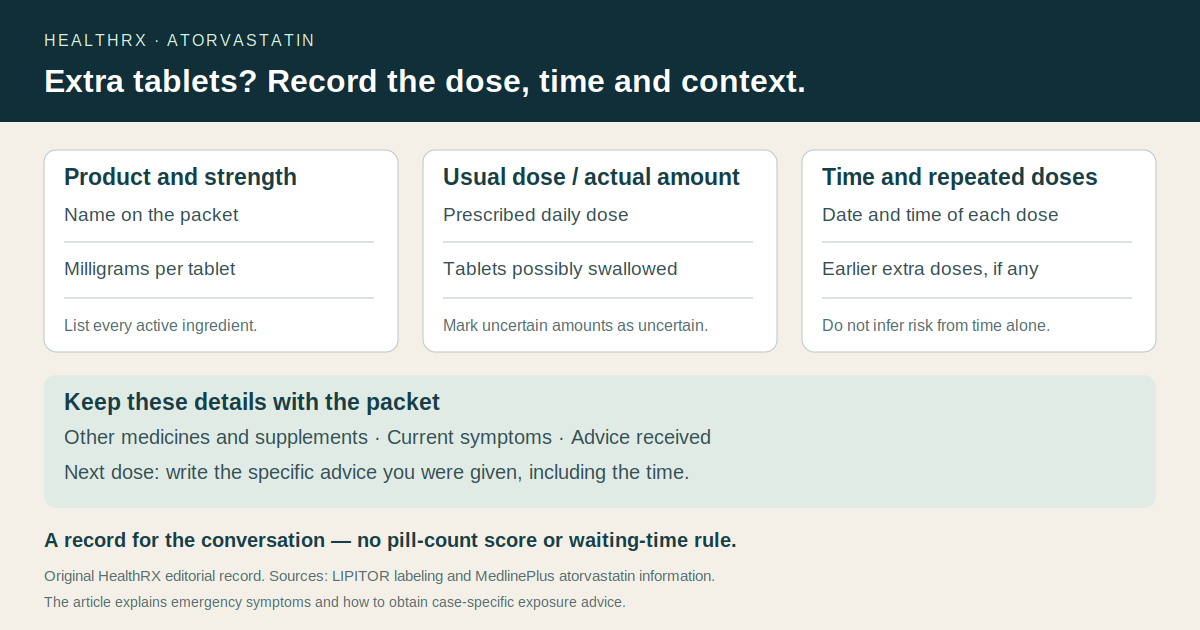
Copy this table into a note or write it on paper. Leave unknown fields marked “unknown.” The same record lets a pharmacist, poison specialist or caregiver work from the same details. Update it after each conversation so another caregiver can see what happened without relying on memory.
| Detail | What to record |
|---|---|
| Product and strength | Packet name, tablet strength, liquid concentration or combination ingredients |
| Usual prescription | Milligrams per dose and usual dosing time |
| Possible amount taken | Number of tablets or liquid volume; minimum and maximum if uncertain |
| Dates and times | Each possible dose, including repeated extra doses |
| Other medicines and supplements | Names, doses if known, and recent changes |
| Symptoms | What happened, when it began, and changes since then |
| Advice received | Who you spoke with, time of call and instructions |
| Next dose plan | Exact instructions, including when to call back |
Keep the record beside the packet during the call. If referred for care, take the packet, remaining medicine and other medicines with you. 4
Symptoms and medicines that change the assessment
Report unexplained muscle pain, tenderness or weakness, especially with fever or unusual tiredness. Severe muscle symptoms, red-brown urine or yellow skin or eyes warrant prompt medical help. 3 4
Higher doses, age 65 or older, kidney impairment, uncontrolled hypothyroidism and interacting medicines increase muscle-injury risk. Cyclosporine or gemfibrozil with atorvastatin is not recommended. Clarithromycin, itraconazole and certain antivirals need drug-specific management. 1
Give the adviser the medicine names rather than trying an online “equivalent dose” calculation. Include recent starts and stops in the record. Symptoms alone cannot establish the amount taken or replace an exposure assessment.
What assessment and treatment can involve
Depending on the event, clinicians may assess muscle injury, kidney function and liver health. Testing and observation are individualized; there is no label-established routine testing interval or universal discharge rule. No specific antidote is known. Hemodialysis is not expected to substantially remove atorvastatin because it is extensively protein-bound; dialysis may still support a patient with a complication. 1
Activated charcoal is a clinical decision based on the substance, formulation, time since ingestion, expected toxicity and airway risk. A 2026 toxicology collaboration recommends later use for selected poisons, rather than one universal time window. That guidance does not turn an online charcoal or IV-treatment recipe into an atorvastatin treatment plan. Do not self-administer charcoal. 5
Agree on the next dose and prevent repeat uncertainty
Ask the adviser or pharmacist exactly when to take the next prescribed dose, and write the answer down. Ordinary missed-tablet instructions say to skip the missed tablet and never double up; they do not establish a next-day plan after an overdose. 3
Choose one person to maintain the dose log. A dated organizer or blister pack may help make doses visible, although packaging research shows variable adherence benefits and does not promise elimination of errors. 7
What research cannot tell you
Research on hospitalized rhabdomyolysis during prescribed lipid-lowering treatment cannot supply a safe pill count or an acute atorvastatin-overdose fatality estimate. 6 Muscle-injury mechanisms also remain incompletely understood; a simple pathway from extra tablets to predictable injury would overstate the evidence. 8
Frequently asked questions
Can you overdose on atorvastatin?
What happens if I accidentally take two atorvastatin pills?
How does atorvastatin (Lipitor) work?
What is the maximum safe dose of atorvastatin?
Does atorvastatin overdose cause liver damage?
Can atorvastatin overdose cause rhabdomyolysis?
Is hemodialysis effective for atorvastatin overdose?
Should I go to the ER for a Lipitor overdose?
What medications make atorvastatin overdose more dangerous?
How long does it take for atorvastatin overdose symptoms to appear?
What is the treatment for atorvastatin overdose?
Is atorvastatin overdose fatal?
References
- Viatris. LIPITOR prescribing information. DailyMed.
- National Capital Poison Center. What you should know about controlling cholesterol with statins.
- MedlinePlus. Atorvastatin. Revised February 15, 2026.
- NHS. Atorvastatin.
- Hoegberg LCG, et al. Recommendations from the Clinical Toxicology Recommendations Collaborative on the administration of activated charcoal in acute oral overdose. Clinical Toxicology. 2026;64(6):419–475.
- Graham DJ, et al. Incidence of hospitalized rhabdomyolysis in patients treated with lipid-lowering drugs. JAMA. 2004;292:2585–2590.
- Mahtani KR, et al. Reminder packaging for improving adherence to self-administered long-term medications. Cochrane Database of Systematic Reviews. 2011;CD005025.
- Apostolopoulou M, et al. The role of mitochondria in statin-induced myopathy. European Journal of Clinical Investigation. 2015;45:745–754.