Prolia Every Six Months: Appointments, Blood Tests and Treatment Reviews
Prolia is a 60 mg healthcare-provider injection every six calendar months. Prolia and Xgeva contain denosumab but use different schedules and are not used together. Six months is not a fixed 182-day interval. [1]
Keep appointments connected to treatment reviews
Before leaving each appointment, record the actual injection date and arrange the next visit. Add reminders early enough to resolve insurance authorization, travel, transport or clinic availability. Keep the appointment details somewhere both you and anyone helping with your care can find them.
Timely appointments matter because denosumab’s protective effect reverses after treatment stops. The Endocrine Society advises against delaying or stopping it without subsequent treatment to limit rebound bone turnover, bone loss and fracture risk. A planned treatment review should therefore happen before a decision to interrupt injections. [2]
If your injection is already late, contact the prescribing team rather than waiting for a routine review. The late-dose guide covers that separate situation.
Blood tests depend on your risk
Selected patients predisposed to hypocalcemia need calcium and mineral checks 10–14 days afterward. Advanced CKD requires calcium checks weekly for the first month, then monthly. Your team sets the appropriate testing plan. [1]
The FDA’s boxed warning emphasizes severe hypocalcemia in advanced kidney disease, especially dialysis and chronic kidney disease–mineral and bone disorder. Existing low calcium needs correction before treatment. Treatment selection, calcium and vitamin D management, and monitoring require an experienced clinical team. Lack of a renal dose adjustment does not make treatment low-risk in this group. [3]
Ask which tests your clinician wants, when they should be completed, and who will review the results before the appointment. Do not assume that an old laboratory result or a supplement plan from another person is suitable for your next visit.
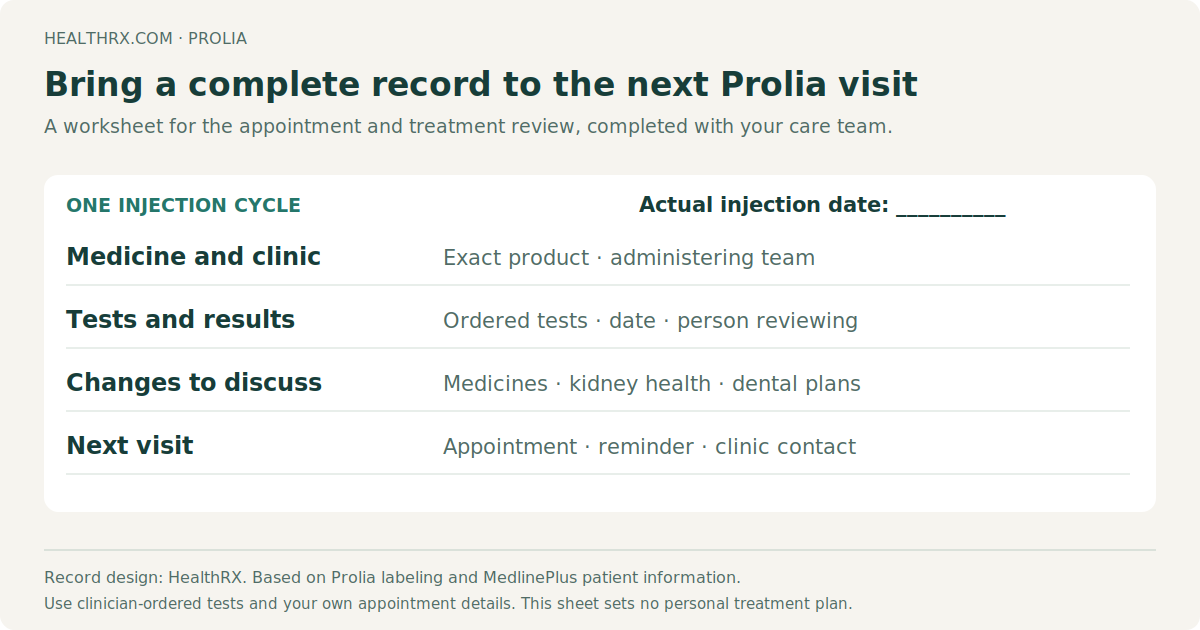
Your ongoing-care appointment worksheet
Use one copy for each injection cycle. This separates your records from tests or treatment changes that require a clinician’s decision.
| Stage | Records to bring or complete | Questions for the care team |
|---|---|---|
| Before the visit | Last actual injection date; appointment details; updated medicine and supplement list; new symptoms, fractures or dental plans | Which blood tests are ordered? When and where should they be done? Who checks the results? |
| At the visit | Actual injection date; administering clinic; any tests reviewed; agreed follow-up instructions | Has my fracture risk or kidney health changed? Is the current treatment still appropriate? |
| After the visit | Next appointment; reminders; contact number; dates of any ordered follow-up tests | Who should I contact about symptoms, abnormal results or scheduling problems? |
Leave space beneath the worksheet for unresolved questions. If an appointment changes, update both your calendar and the clinic’s record rather than relying on an earlier booking confirmation.
What the main studies establish
These studies answer different questions. Bone mineral density (BMD) improvement is useful evidence, but it is not the same endpoint as preventing fractures.
| Study | Design and participants | Main finding and limitation |
|---|---|---|
| FREEDOM | Three-year placebo-controlled trial; 7,868 postmenopausal women | New radiographic vertebral fractures occurred in 2.3% with denosumab versus 7.2% with placebo—a 68% relative reduction. [5] |
| FREEDOM extension | Open-label extension; 4,550 entered and 2,626 completed | Exposure reached ten years in the long-term group. BMD continued increasing; there was no continuing randomized placebo group. Annual new vertebral fracture incidence ranged from 0.90% to 1.86%. [6] |
| Men’s trial | One-year placebo-controlled study; 242 randomized men | The primary endpoint was lumbar-spine BMD, which increased 5.7% with denosumab. It was not a fracture-prevention endpoint. [7] |
Make room for broader treatment decisions
Prolia is approved for certain adults with glucocorticoid-induced osteoporosis. [1]
For people taking glucocorticoids long term, fracture-risk assessment remains important. The American College of Rheumatology guideline includes denosumab among treatment options chosen through shared decision-making; it is not restricted simply to people unable to tolerate oral bisphosphonates. [8]
Keep your dentist informed about osteoporosis medicines. The ADA emphasizes oral health and individualized planning: evidence does not support a routine antiresorptive holiday or waiting period to prevent medication-related jaw osteonecrosis. Dental work should prompt coordination, not an automatic cancelled injection. [4]
Frequently asked questions
What happens if I miss my denosumab injection by a few weeks?
Can I switch from denosumab to a bisphosphonate?
Do I need blood work before every denosumab injection?
How long can I stay on denosumab?
What is the correct vitamin D level before a denosumab injection?
Is denosumab safe for patients with kidney disease?
What is a bisphosphonate holiday and how does it relate to denosumab?
Does denosumab work better than alendronate for osteoporosis?
Can men take denosumab on the same schedule?
What are the signs of rebound bone loss after stopping denosumab?
Should I see a dentist before starting denosumab?
How is denosumab injected and where on the body?
References
- Prolia prescribing information, including dosing and hypocalcemia monitoring — DailyMed.
- Pharmacological Management of Osteoporosis in Postmenopausal Women — Endocrine Society guideline resource.
- FDA boxed warning: severe hypocalcemia with Prolia in advanced chronic kidney disease.
- Osteoporosis Medications and Medication-Related Osteonecrosis of the Jaw — American Dental Association. Topic updated April 11, 2023.
- Cummings et al. Denosumab for prevention of fractures in postmenopausal women with osteoporosis. NEJM, 2009 — abstract.
- Bone et al. Ten years of denosumab treatment: FREEDOM trial and open-label extension. Lancet Diabetes & Endocrinology, 2017 — abstract.
- Orwoll et al. Randomized placebo-controlled study of denosumab in men with low bone mineral density. JCEM, 2012 — abstract.
- Humphrey et al. 2022 ACR Guideline for Prevention and Treatment of Glucocorticoid-Induced Osteoporosis. Published 2023 — abstract.
- MedlinePlus: Denosumab Injection, revised June15,2026.