Stopping Dutasteride: Follow-Up After the Last Dose
The useful starting point is why you want to stop: side effects, fertility goals, uncertain hair benefit, or a change in BPH treatment. Record that reason alongside your dose, treatment duration, last-dose date and other medicines. This gives you and your prescriber a starting point for judging what changes afterward.
The AVODART label does not describe a taper. Dutasteride leaves the body slowly: its terminal half-life at steady state is approximately five weeks, and serum levels can remain detectable for four to six months after stopping. Detectability does not establish when DHT, urinary symptoms, hair growth or sexual function will return to a particular level.[1]
Make a record you can compare over time
Write down your current symptoms before stopping, if possible. Include their effect on daily life: interrupted sleep, difficulty emptying your bladder, sexual difficulties or concern about thinning hair. Note when symptoms began relative to starting dutasteride and whether other medicines changed around the same time.
| Concern | Useful information to record | What it helps assess |
|---|---|---|
| BPH and urination | Nighttime bathroom trips, urgency, weak stream, straining, incomplete emptying and any previous urinary retention | Whether urinary control worsens after stopping |
| PSA | Pre-treatment, on-treatment and subsequent PSA results with dates; treatment duration and last dose | How dutasteride exposure affects interpretation |
| Hair | Dated photographs using similar lighting, angle, hairstyle and hair length | Visible change rather than day-to-day impressions |
| Sexual symptoms | Changes in desire, erections or ejaculation; onset, severity and effect on daily life | Whether symptoms improve, persist or change |
| Fertility concerns | Conception plans, previous fertility difficulties and any existing semen results | Whether individual fertility assessment would be useful |
Choose follow-up timing with your clinician according to the reason for stopping and your history. Research visit schedules describe how investigators collected data; they are not prescriptions for everyone stopping treatment.
If you take dutasteride for BPH
Clarify which medicine is being stopped, particularly if you also take an alpha blocker. Continuing an alpha blocker does not guarantee that urinary symptoms will remain controlled after dutasteride withdrawal.
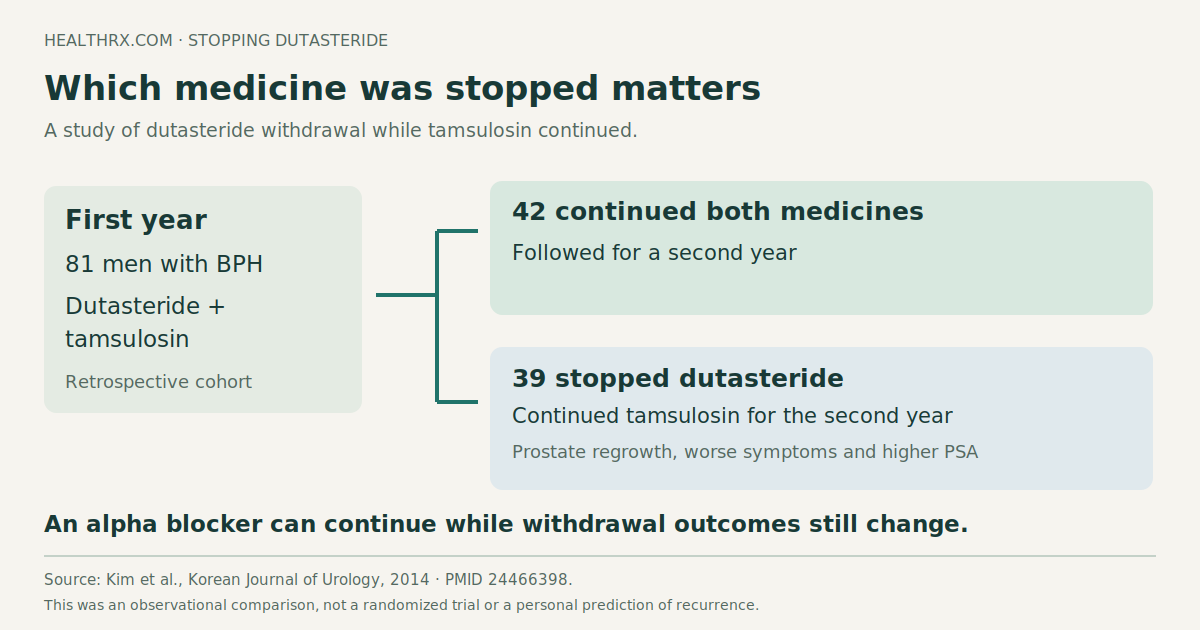
Kim and colleagues retrospectively studied 81 men who received dutasteride plus tamsulosin for one year. During the next year, 42 continued both medicines and 39 stopped dutasteride while continuing tamsulosin. Researchers measured symptom scores, prostate volume and PSA at baseline, 12 months and 24 months. Stopping dutasteride was associated with prostate regrowth, worsening lower urinary tract symptoms and increased PSA. This was a retrospective comparison, not a tapering trial.[2]
A randomized multicenter withdrawal study examined stopping either dutasteride or doxazosin after two years of combination treatment. Among study completers, 117 stopped dutasteride and 113 stopped the alpha blocker. Combination treatment was resumed within 12 months by 51.3% and 31.0%, respectively. These figures compare which medicine was withdrawn; they do not compare stopping with continuing both medicines or predict your personal outcome.[3]
In a prospective pilot study of 20 men, 12 restarted dutasteride between six and 12 months after stopping while continuing an alpha blocker. Investigators tracked symptom scores, prostate measurements, urinary flow, residual urine and PSA. The small, selected sample and patients’ choice to restart limit how broadly the findings apply.[4]
Agree in advance which changes should prompt contact, especially worsening emptying or increasingly disruptive symptoms. Inability to urinate or severe abdominal pain needs urgent assessment.[7]
Keep PSA results attached to treatment dates
Dutasteride lowers PSA by approximately 50% within three to six months after starting. The label recommends establishing a new PSA baseline after at least three months on treatment and doubling an isolated PSA value for comparison with untreated reference values after three months on therapy.[1]
That on-treatment instruction is not an automatic post-stop doubling rule. There is no universal date when a result becomes your “true baseline.” Give the clinician interpreting your PSA the actual results and dates, including pre-treatment values if available, plus your treatment duration and last-dose date. A rising result needs interpretation in that context rather than an assumption that every increase comes from stopping.
Hair, sexual symptoms and fertility
For hair, use comparable photographs to document changes. The 917-man Gubelin Harcha trial measured hair counts, hair width and photographic outcomes during 24 weeks of treatment. It did not establish a month-by-month hair-loss timeline after withdrawal.[5] Discuss the benefit you noticed and your goals before deciding whether another treatment is appropriate.
For sexual symptoms, record the specific difficulty and its course. The label states that sexual adverse reactions may persist after discontinuation, while dutasteride’s causal role in persistence is unknown.[1] A guaranteed resolution date would therefore be misleading. Persistent or troublesome symptoms deserve assessment rather than an assumption that drug clearance settles the question.
Semen findings also require individual interpretation. Amory and colleagues randomized 99 healthy men to dutasteride, finasteride or placebo for one year, with laboratory follow-up 24 weeks after stopping. Group changes in semen parameters appeared partly reversible, but some measures remained reduced at follow-up. The study did not establish that every participant returned to baseline or determine an individual’s fertility.[6] Conception plans and prior fertility problems can guide whether semen testing would answer a useful question.
Blood donation: wait at least six months
Do not donate blood until at least six months after your last dutasteride dose. This is the label’s minimum waiting period, separate from any symptom changes you notice.[1]
Frequently asked questions
Can dutasteride be stopped without tapering?
Is the long half-life a built-in taper?
How long should I wait before donating blood after stopping dutasteride?
Can BPH symptoms return after stopping?
When will hair loss resume after stopping dutasteride?
Should PSA still be doubled after stopping?
Do sexual side effects always resolve after stopping?
Does everyone need a semen analysis after stopping?
References
- Waylis Therapeutics. AVODART prescribing information, revised October 2023; DailyMed updated March 12, 2025. Source
- Kim W et al. Clinical effects of discontinuing 5-alpha reductase inhibitor in patients with benign prostatic hyperplasia. 2014. Source
- Lin VC et al. Progression of lower urinary tract symptoms after discontinuation of 1 medication from 2-year combined alpha-blocker and 5-alpha-reductase inhibitor therapy for benign prostatic hyperplasia in men--a randomized multicenter study. 2014. Source
- Shindo T et al. Significance of intraprostatic architecture and regrowth velocity for considering discontinuation of dutasteride after combination therapy with an alpha blocker: a prospective, pilot study. 2015. Source
- Gubelin Harcha W et al. A randomized, active- and placebo-controlled study of the efficacy and safety of different doses of dutasteride versus placebo and finasteride in the treatment of male subjects with androgenetic alopecia. 2014. Source
- Amory JK et al. The effect of 5alpha-reductase inhibition with dutasteride and finasteride on semen parameters and serum hormones in healthy men. 2007. Source
- NIDDK. Symptoms and Causes of Urinary Retention. Source