Spironolactone With Testosterone: Acne, Treatment Goals and Blood Tests
Can spironolactone and testosterone be taken together?
Having both prescriptions deserves a review of why each was prescribed. Spironolactone has antiandrogenic effects that may work against some intended effects of testosterone. It also treats conditions unrelated to androgen activity, including heart failure and high blood pressure. Those separate purposes matter when deciding whether both medicines belong in a treatment plan. [1, 2]
The next step depends on why the medicines were prescribed. For someone using testosterone for masculinization and spironolactone for acne, the main question is whether acne can be controlled without interfering with desired hormone effects. For someone taking spironolactone for heart failure, stopping it could disrupt an important treatment. Both prescribers need the same medication list and a clear account of the goals.
How their effects can conflict
Testosterone supplies an androgen signal. Spironolactone has antiandrogenic activity, which helps explain its use for hormonal acne and adverse effects such as breast enlargement. A conflict in tissue effects does not necessarily mean that one medicine lowers the other's measured blood concentration. [1, 2]
There is no established testosterone blood level at which spironolactone suddenly stops helping acne. Nor should prescribed testosterone be assumed to produce above-normal levels: the intended range depends on the indication and the person's treatment goals. [3, 4]
Claims that spironolactone reliably lowers testosterone by a particular percentage are also misleading. In a short 1975 study, healthy male volunteers received 400 mg daily for five days, and plasma testosterone did not change. That short study does not establish what happens during long-term acne treatment, testosterone replacement, or gender-affirming care. It illustrates why receptor effects and blood hormone levels should not be treated as interchangeable. [6]
Start with the purpose of each prescription
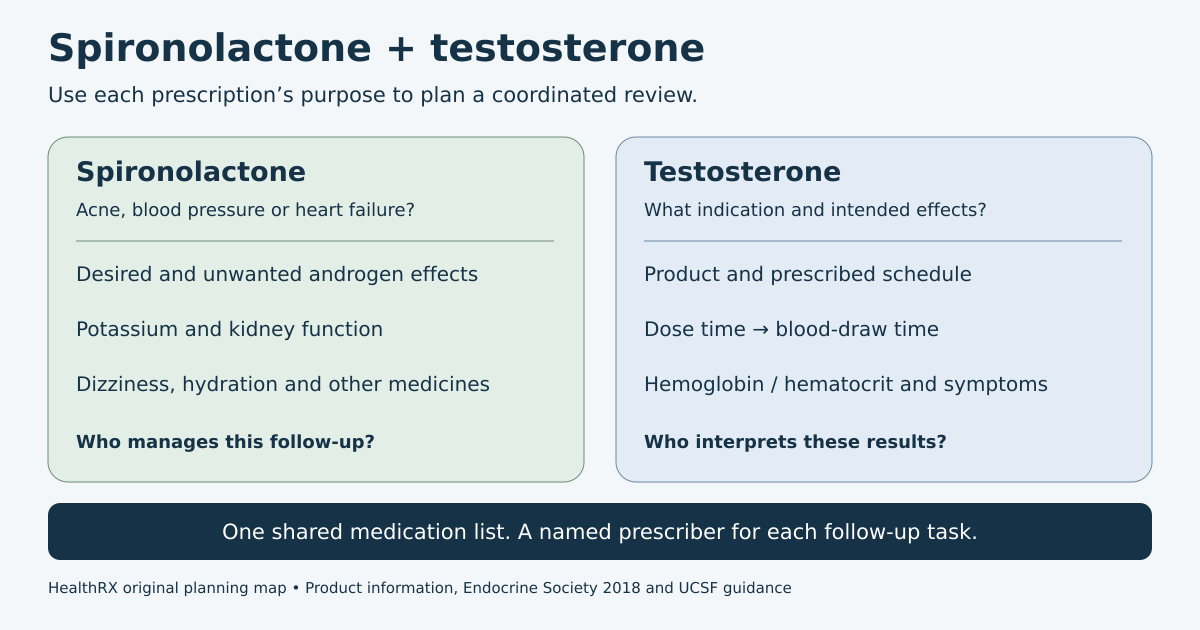
Use this map to prepare for a joint medication review. Bring the completed notes to the prescribers managing these medicines.
| Medication purpose | Decision to clarify | Useful questions and records |
|---|---|---|
| Acne control while preserving masculinization | Whether spironolactone fits the intended testosterone effects | Bring an acne-treatment history and testosterone formulation; ask about acne options that preserve hormone goals. |
| Heart failure or blood pressure treatment with a separate testosterone indication | Whether both medicines remain needed for their independent purposes | Bring the cardiac diagnosis, blood pressure readings, kidney results, and complete medication list; ask who manages potassium testing. |
| Individualized hormone goals | Which androgen effects are desired and which are unwanted | Describe desired changes and troublesome symptoms; bring hormone results with collection dates and injection or application timing. |
| An unexplained or outdated medication list | Whether the overlap is intentional | Bring bottles, doses, start dates, and prescriber names; ask each office to confirm the current plan before making changes. |
Acne can be treated while testosterone continues
Testosterone can cause or worsen acne, but a flare is not inevitable. Acne does not prove that a testosterone dose is excessive, and it does not automatically mean testosterone must stop. The American Academy of Dermatology describes acne treatment during gender-affirming testosterone therapy. [5]
For mild acne, options may include adapalene, benzoyl peroxide, or salicylic acid. More persistent, moderate, or severe acne may need prescription treatment. Painful nodules and scarring warrant dermatology assessment rather than repeated changes to hormones without a coordinated plan. [5]
If spironolactone is being used only for acne, ask whether another acne treatment would better fit the desired testosterone effects. If it is also treating heart failure or blood pressure, an acne substitution alone does not replace that cardiovascular treatment. Do not stop either prescription or increase testosterone to try to overcome spironolactone's effects.
Separate the actual safety concerns
Spironolactone can raise potassium, particularly when kidney function is impaired or other potassium-raising medicines are present. Its prescribing information also addresses low blood pressure, dehydration, and worsening kidney function. Potassium supplements, potassium-containing salt substitutes, and other medicines belong in this review. [1]
Testosterone cypionate can cause fluid retention and increased red blood cell levels. Its edema warning does not establish a combined hyperkalemia rate with spironolactone. These risks need their own assessment, especially in someone with cardiac or kidney disease. [2]
Breast enlargement is another relevant concern. The Aldactone label reports gynecomastia in about 9% of male participants in the RALES heart-failure trial, at a mean spironolactone dose of 26 mg daily. This is not an incidence estimate for people taking both medicines, and it is not a risk limited to doses above 50 mg. [1]
New palpitations with marked weakness, fainting, chest pain, or severe breathlessness need urgent assessment. Potassium elevation may have no symptoms, so feeling well does not replace indicated laboratory testing. [1, 2]
Blood tests must match the indication and formulation
Potassium and kidney function: The Aldactone label calls for potassium testing within one week of starting or titrating treatment and regularly afterward. Kidney function, other medicines, and the reason for treatment affect follow-up. This label-based advice should not become an identical testing schedule for every otherwise healthy person receiving spironolactone for acne. [1]
Testosterone: Record the product, dose schedule, and time between the last dose and the blood draw. In the Endocrine Society guideline for men with hypogonadism, injected testosterone cypionate or enanthate is measured midway between injections. A routine instruction to draw every injectable testosterone level immediately before the next dose would misstate that guidance. [3]
For masculinizing therapy, UCSF guidance emphasizes individual goals and interpretation by formulation and timing. Midcycle testing is often sufficient for injections; peak and trough measurements may help evaluate cyclic symptoms. A serum value alone cannot measure how much androgen activity spironolactone is blocking in a particular tissue. [4]
Hemoglobin and hematocrit: The male-hypogonadism guideline recommends hematocrit at baseline, three to six months after starting testosterone, and annually thereafter. A result above 54% calls for clinician-directed interruption and evaluation before a restart plan. These recommendations come from that population, not a trial establishing a monitoring schedule for this drug pair. Spironolactone should not be relied on to prevent testosterone-related erythrocytosis. [2, 3]
What to clarify with both prescribers
Ask each prescriber to confirm the indication, desired effects, and responsibility for follow-up. Share laboratory results with collection timing, recent symptoms, and all hormonal products, including supplements. DHEAS contributes to making testosterone and estrogen; that supports reviewing DHEA products, but does not establish how a supplement will affect an individual's acne. [8]
There is no established universal washout period or fixed transition schedule for this pairing. Separating doses by a few hours does not resolve their opposing treatment goals. If a change is appropriate, the prescribers should specify which medicine changes, how the original condition will remain treated, and which symptoms or results will prompt reassessment.
Frequently asked questions
Can I take spironolactone with testosterone?
Is it safe to combine spironolactone and testosterone?
Does spironolactone lower testosterone levels?
Will testosterone make my acne worse if I am on spironolactone?
What can I take instead of spironolactone if I need testosterone therapy?
Does spironolactone cause gynecomastia in men on testosterone?
How long should I wait between stopping spironolactone and starting testosterone?
Can spironolactone and testosterone be used together in transgender patients?
What labs should I get if I am on both spironolactone and testosterone?
Does spironolactone affect testosterone blood test results?
Is eplerenone safer than spironolactone with testosterone?
Can DHEA supplements interfere with spironolactone for acne?
References
- Pfizer. Aldactone (spironolactone) prescribing information.
- Pfizer. Depo-Testosterone (testosterone cypionate) prescribing information.
- Bhasin S, Brito JP, Cunningham GR, et al. Testosterone Therapy in Men With Hypogonadism: An Endocrine Society Clinical Practice Guideline. Journal of Clinical Endocrinology & Metabolism. 2018;103(5):1715–1744.
- UCSF Gender Affirming Health Program. Overview of masculinizing hormone therapy.
- American Academy of Dermatology. Acne and gender-affirming testosterone therapy.
- Stripp B, Taylor AA, Bartter FC, et al. Effect of spironolactone on sex hormones in man. Journal of Clinical Endocrinology & Metabolism. 1975;41(4):777–781.
- DailyMed. Inspra (eplerenone) prescribing information.
- MedlinePlus. DHEA Sulfate Test.