Isotretinoin and Food: Check Your Capsule Before Changing Your Diet
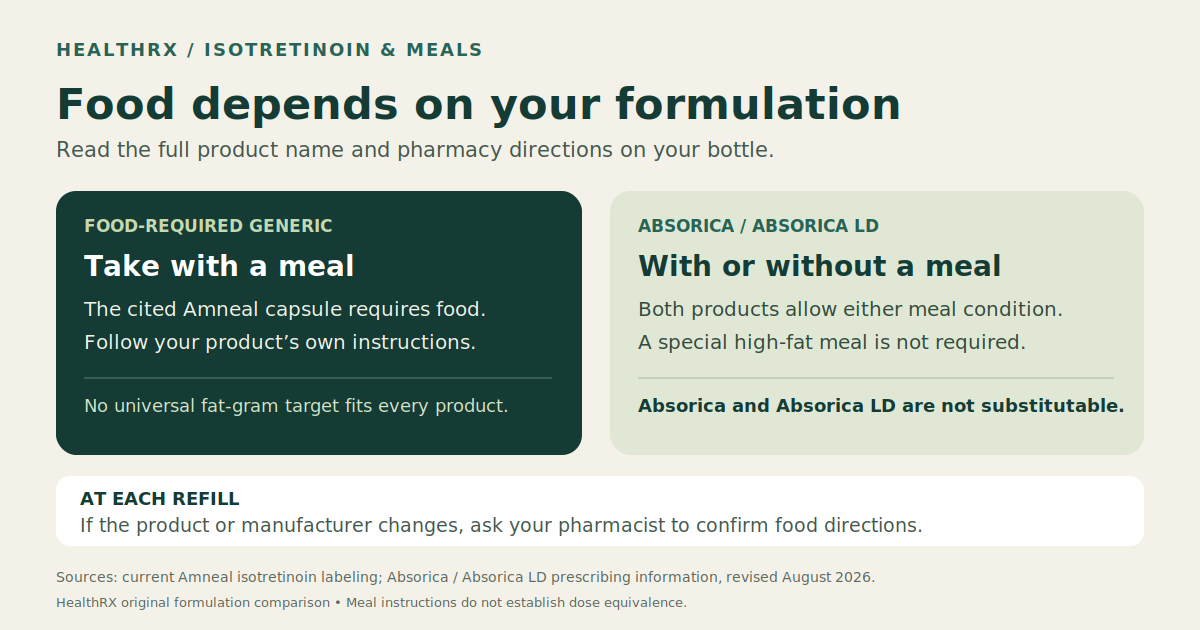
Your first nutrition decision starts with the capsule bottle. Some isotretinoin capsules need food; Absorica and Absorica LD may be taken with or without it. A meal rule copied from someone else’s prescription may not fit yours. Check the product name, manufacturer and pharmacy directions before changing how you eat.[1,2]
Match the meal instruction to your formulation
Identify the product before planning meals.
| Capsule on your prescription | Food instruction | Practical next step |
|---|---|---|
| Generic isotretinoin whose label requires food, including the cited Amneal product | Take with food.[2] | Pair it with a regular meal according to your prescription. Ask the pharmacist if the bottle’s instructions are unclear. |
| Absorica | May be taken with or without meals.[1] | Follow your prescribed schedule; a special meal is not required. |
| Absorica LD | May be taken with or without meals.[1] | Confirm the full product name, including “LD,” when checking instructions. |
Absorica and Absorica LD are not interchangeable: their exposure and recommended doses differ. Do not use this table to switch products or calculate a replacement dose.[1]
At a refill, compare the name and manufacturer with your previous bottle. If either changes, have the pharmacist confirm the food directions. For a food-required capsule accidentally taken without a meal, do not take an extra capsule to compensate; ask how to handle the next scheduled dose. Skip a missed dose rather than taking two together.[2]
Build a meal you can repeat
You can generally continue your usual diet unless your prescriber recommends a change.[5] For a capsule that requires food, choose a familiar meal rather than trying to reproduce a laboratory test meal. Possible pairings include:
- Eggs, toast and fruit.
- Oatmeal with yogurt and nuts, if you eat those foods.
- A bean-and-cheese burrito with vegetables.
- A chicken, tofu or hummus sandwich with your usual sides.
- Rice or potatoes with fish, beans or another protein and vegetables.
These examples are ordinary meal ideas, not validated absorption recipes. Product labels do not define one fat-gram target that fits every patient and formulation.[1,2] If you routinely skip meals, eat very small portions or have a medical diet restriction, ask the pharmacist how to fit your particular capsule into that routine.
There is no need to organize the whole day around a special “isotretinoin diet.” Keep foods you enjoy and can afford. If blood tests change, your clinician can help identify which eating habits, medicines or other factors deserve attention rather than imposing an unnecessary blanket restriction.
Read supplement ingredients, not just the front label
Bring a list or photos of everything you take, including gummies, powders, herbal products and occasional supplements.[5] A product marketed for hair, skin or fitness may combine several ingredients.
Use this checklist before starting or continuing one:
- Vitamin A: Look for vitamin A, retinol, retinyl acetate or retinyl palmitate, and record the amount per serving. Avoid vitamin A supplements during isotretinoin treatment because of potentially additive adverse effects. Check multivitamins and fish-liver oils too.[1]
- Biotin: Record the amount and units, especially on hair-and-nail products. Tell the clinician and laboratory before testing. Biotin can distort susceptible assays; FDA warnings include falsely low troponin results. This does not mean every cholesterol or liver test is affected. Ask about the actual assay and any hold instructions; there is no universal washout period.[7]
- St. John’s wort: Include it on your medication list for the pharmacist’s review, and ask your prescriber before using it.[1]
- Omega-3s and blends: Record the ingredients, serving size, amount taken and reason for use. Distinguish ordinary fish oil from fish-liver oil, which may contain vitamin A. Have the product reviewed rather than assuming every supplement is either necessary or forbidden.[1,5]
Keep a lab-preparation record
Isotretinoin monitoring includes fasting lipids and liver tests.[2] Before the appointment, ask which tests were ordered, whether fasting is required, how long to fast and how to handle your capsule if it normally goes with a meal. Avoid guessing between conflicting bottle and laboratory instructions.
Save this short record on your phone:
| What to record | Your note |
|---|---|
| Product | Exact name and manufacturer |
| Test instructions | Ordered tests, fasting window and who supplied instructions |
| Food and capsule | Last meal time; last capsule time and whether taken with food |
| Alcohol | Last drink date and time |
| Supplements | Product, amount and last use; any specific hold instructions |
| Follow-up | Who will review results and when to contact them |
The Absorica/Absorica LD label specifies waiting at least 36 hours after alcohol before fasting lipid testing. That interval concerns test preparation; it does not establish when drinking is safe during treatment.[1] Give the testing team an accurate record if preparation differed from instructions.
What the small omega-3 study actually found
A retrospective study included 39 people taking isotretinoin: 19 reported consistent voluntary omega-3 supplement use and 20 reported none. Median treatment lasted 5.87 months. Among participants whose triglycerides were already elevated, the reported mean increase was 49% without supplements versus 13.91% with supplements, with P=.04.[3]
The results came from a subgroup of the 39 participants. People chose whether to take supplements, and the researchers did not assign a standardized product or dose. The findings cannot establish an effective dose, predict your response or show that an over-the-counter product can replace treatment for high triglycerides. The authors called for controlled confirmation.[3]
Dryness and digestive symptoms need different responses
Drink regularly according to thirst and your usual needs, including any clinician-directed fluid limits. A fixed daily water quota is not established treatment for isotretinoin dryness. Moisturizer and lip protection are more directly relevant to dry skin and lips.[6]
Severe abdominal pain, rectal bleeding or severe diarrhea needs prompt medical attention: stop isotretinoin and contact your clinician rather than trying to manage it with food or supplements.[2] Population-level bowel-disease research does not override those symptom instructions.
Frequently asked questions
What should I eat when taking isotretinoin?
Can I take vitamins while on isotretinoin?
Does isotretinoin raise cholesterol or triglycerides?
Can I drink alcohol while taking isotretinoin?
How much water should I drink while on isotretinoin?
Does isotretinoin cause inflammatory bowel disease?
Can I take fish oil with isotretinoin?
References
- DailyMed: Absorica and Absorica LD prescribing information and medication guide.
- DailyMed: Amneal isotretinoin capsule prescribing information and medication guide.
- Krishna et al.: Influence of omega-3 fatty acids on triglyceride levels in patients using isotretinoin.
- 2023 systematic review and meta-analysis: Isotretinoin exposure and inflammatory bowel disease risk.
- MedlinePlus: Isotretinoin patient medication information.
- American Academy of Dermatology: Managing isotretinoin side effects.
- FDA: Biotin interference with troponin and other susceptible laboratory assays.