Retatrutide and Autoimmune Disease: What the Trials Actually Establish
Retatrutide’s weight-loss results do not answer whether it treats autoimmune disease or is safe for a particular person with one. Those are separate research questions. The reviewed trials establish outcomes in selected populations; they do not establish disease-specific benefit or safety for rheumatoid arthritis, lupus, inflammatory bowel disease or autoimmune thyroid disease.
The key is to distinguish who could enter a study from who actually participated, and to distinguish the outcomes researchers measured from the outcomes a reader hopes to improve. A broad diagnosis such as “arthritis” is not enough to bridge those gaps.
What the obesity trials measured
Retatrutide activates three receptors: GIP, GLP-1 and glucagon. It is a glucagon agonist, not an antagonist. In the phase 2 obesity trial, 338 adults were studied over 48 weeks. Mean body-weight change with the 12-mg dose was −24.2%, compared with −2.1% with placebo. Gastrointestinal adverse events were the most common and were dose-related. These are weight and tolerability findings, not evidence of autoimmune remission. [2]
The phase 3 TRIUMPH-1 report, published in the New England Journal of Medicine on September 29, 2026, randomized 2,339 adults without diabetes over 80 weeks. It included 574 participants in a knee osteoarthritis population and 243 in an obstructive sleep apnea population. Its primary outcomes concerned body weight, WOMAC knee pain and apnea–hypopnea frequency—not rheumatoid arthritis, lupus or IBD activity. [4]
A person may value weight loss without expecting it to treat an autoimmune condition. But a treatment recommendation for that condition needs evidence about the disease itself, including clinically meaningful benefits and harms in the relevant population.
What autoimmune eligibility rules actually say
Exclusion 43 in the phase 2 protocol concerned recent chronic systemic glucocorticoids, or significant active autoimmune disease requiring those medicines recently or likely during the study. It did not categorically exclude every autoimmune diagnosis or every immunosuppressive medicine.[1]
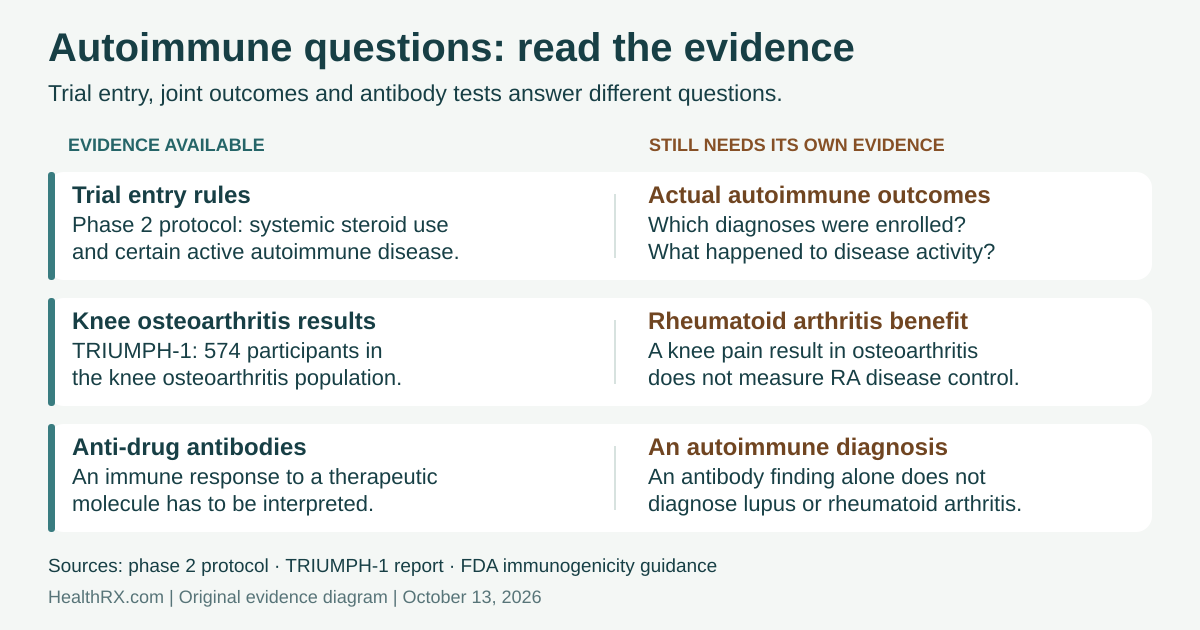
The distinction matters in both directions. The protocol does not justify saying that no autoimmune patients participated. Nor does a potentially permissible diagnosis establish how many enrolled, their disease activity or whether they experienced flares. Eligibility criteria select a research population; they are not universal contraindications or a substitute for an individual assessment.
A short public registry summary can also omit qualifications present in the full protocol. Reading an abridged exclusion list as permission to participate—for example, assuming stable rheumatoid arthritis qualifies—goes beyond what it establishes.
Three distinctions that change the interpretation
| Evidence distinction | What the evidence addresses | What would be needed for the stronger claim |
|---|---|---|
| Eligibility versus enrollment and outcomes | Eligibility rules describe permitted or excluded circumstances. | Participant diagnoses, disease activity, treatments and disease-specific results are needed to establish experience in an autoimmune subgroup. |
| Osteoarthritis versus autoimmune arthritis | Osteoarthritis involves structural joint damage, including cartilage damage; rheumatoid arthritis involves immune attack. | Rheumatoid arthritis outcomes must be measured in people with that diagnosis. An osteoarthritis pain result cannot establish control of autoimmune arthritis. |
| Anti-drug antibodies versus autoimmune disease | Anti-drug antibody testing investigates an immune response to a therapeutic molecule. | A positive antibody test alone neither diagnoses new lupus or rheumatoid arthritis nor demonstrates treatment of either disease. |
The word “arthritis” therefore cannot transfer an osteoarthritis trial finding to rheumatoid arthritis. A fall in weight does not measure remission. A knee-pain score does not identify the cause of joint disease. The arthritis distinction comes from NIAMS.[5] Anti-drug antibodies describe a response to the therapeutic molecule; their clinical significance requires additional assessment.[8]
Why the knee osteoarthritis population matters
TRIUMPH-1’s public registry describes knee osteoarthritis and sleep apnea populations within the adult obesity trial. The knee osteoarthritis basket excludes joint disease other than osteoarthritis, steroid joint injections within 90 days, and other joint injections or procedures within six months. These are basket-specific rules, not blanket criteria for the entire trial. [3]
This helps explain why a knee-pain finding should not be described as evidence that retatrutide treats inflammatory arthritis. The selected joint condition and the measured endpoint determine what the result can support.
What safety findings cannot settle
Gastrointestinal symptoms reported during treatment do not, by themselves, diagnose an IBD flare. For someone with Crohn’s disease or ulcerative colitis, distinguishing medication symptoms from disease activity requires clinical assessment; a general adverse-event category cannot resolve that distinction.
Similarly, an obesity outcome cannot establish a clinical immunomodulation recommendation. Mechanistic plausibility may justify research, but it does not supply the missing autoimmune outcomes. Observations involving other medicines must not be relabeled as retatrutide results.
Questions worth bringing to a trial discussion
Bring your exact diagnosis, current disease activity and actual medication list, including steroid route and timing. Ask: Does the selected study population match my condition? What does the full protocol say about my treatment? Does the trial measure my autoimmune disease, or only weight and related outcomes? Those questions are more useful than treating either eligibility or weight loss as proof of autoimmune safety.
For the separate medication-interaction question, see the retatrutide interaction evidence guide.
Frequently asked questions
Is retatrutide FDA-approved?
Can I take retatrutide if I have rheumatoid arthritis?
Does retatrutide affect the immune system?
Is there an IBD warning for retatrutide?
Can patients with type 1 diabetes use retatrutide?
How does retatrutide compare to semaglutide for weight loss?
What autoimmune conditions might benefit from GLP-1 class drugs?
Will the TRIUMPH phase 3 trial include autoimmune patients?
Does retatrutide cause thyroid problems?
How do I access retatrutide if I have an autoimmune disease?
What is the starting dose of retatrutide?
Does retatrutide worsen lupus?
References
- Eli Lilly and Company. NCT04881760 study protocol, approved August 29, 2022. Exclusions 15 and 43; printed pages 36 and 39. Full protocol
- Jastreboff AM, et al. Triple-Hormone-Receptor Agonist Retatrutide for Obesity — A Phase 2 Trial. N Engl J Med. 2023. PubMed
- ClinicalTrials.gov. TRIUMPH-1, NCT05929066. Current registry checked October 13, 2026. Study record
- Jastreboff AM, et al. Retatrutide, a Triple Hormone Receptor Agonist, for Treatment of Obesity. N Engl J Med. September 29, 2026. DOI 10.1056/NEJMoa2604169. PubMed
- NIAMS. Arthritis and Rheumatic Diseases. Joint conditions
- Novo Nordisk. Wegovy US prescribing information, revised June 2026. Section 5.6. Prescribing information
- FDA. FDA’s Concerns with Unapproved GLP-1 Drugs Used for Weight Loss. Status checked October 13, 2026. Current information
- FDA. Immunogenicity Assessment for Therapeutic Protein Products. August 2014. Definition and interpretation of anti-drug antibodies. Source document