Repatha Reviews and Side Effects: Reading Patient Reports Alongside Trials
A Repatha review can describe a problem worth bringing to an appointment. To judge how often that problem occurs, look for a study with a defined patient group, follow-up period and comparison treatment. A review score, a laboratory result and a decision to stop treatment each answer a different question.
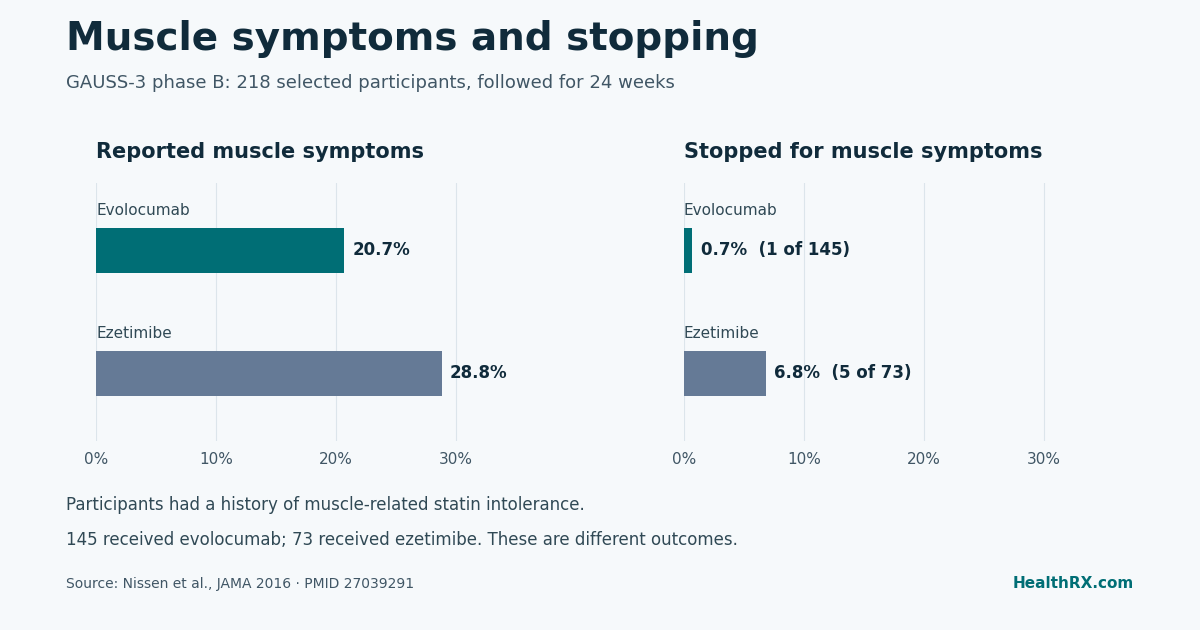
For muscle symptoms, the distinction changes the answer substantially. In GAUSS-3, 20.7% of evolocumab participants reported muscle symptoms; 0.7% stopped treatment for them. Quoting the smaller number as the frequency of muscle symptoms loses most of the reported events. The comparison drug was ezetimibe. 2
Read the denominator before comparing side effects
GAUSS-3 phase B randomized 218 participants with muscle-related statin intolerance to evolocumab or ezetimibe for 24 weeks. Its selected population limits generalization to everyone starting Repatha. 2
| GAUSS-3 phase B outcome | Evolocumab, 145 participants | Ezetimibe, 73 participants |
|---|---|---|
| Reported muscle symptoms | 20.7% | 28.8% |
| Stopped study drug for muscle symptoms | 0.7%, 1 person | 6.8%, 5 people |
| LDL reduction at week 24, from baseline | 52.8% | 16.7% |
The muscle-symptom comparison had a P value of .17, without a statistically significant difference between groups. A symptom report and a treatment-stopping event also have different thresholds: someone may report pain and continue treatment. 2
When comparing a review with a study, write down what was counted. Was it muscle pain, any musculoskeletal event, a clinician-confirmed diagnosis, or stopping because of symptoms? Then check who was eligible and how long researchers followed them. Combining these outcomes into one side-effect percentage makes the comparison difficult to interpret.
What a review can contribute to your own symptom record
A detailed account can suggest useful questions: Did the symptom start after an injection? Was another medicine changed? Did the writer document a repeat laboratory result? Those details can help organize your own account without assuming that another person's diagnosis applies to you.
A star-rating page usually cannot tell you how many treated people had an uneventful course. Even a carefully counted percentage of posted reviews would describe those reviews, rather than everyone who used the medicine. Check the collection date, inclusion rules, duplicate handling and number of reviews before accepting a numerical review summary. A quotation also needs a traceable source before it can support an article's conclusions.
Use a dated record if you are discussing a possible side effect:
| Record item | Detail to bring to the discussion |
|---|---|
| Injection and symptom dates | Actual administration date; when the symptom began and changed |
| Symptom description | Location, severity, duration and effect on usual activities |
| Other treatment changes | Medicine names, dose changes and timing |
| Supporting information | Relevant photographs, examination findings or test results already obtained |
| Agreed next step | Who will review the record and when to contact them again |
This record separates an observed sequence from a conclusion about its cause. It also gives the next person reviewing the concern more information than a rating alone.
How adverse-event reports differ from trial results
A 2022 study examined muscle-related reports involving PCSK9 inhibitors in the FDA Adverse Event Reporting System, or FAERS. It used reporting disproportionality to look for safety signals. It did not enroll a cohort of everyone taking Repatha and measure the proportion who developed symptoms. 6
FDA explains that these reports cannot establish an event's incidence or prove that a medicine caused it. Reporting is incomplete, reports may be duplicated, and other conditions or treatments may contribute. A reporting odds ratio therefore cannot be read as a patient's absolute risk. 7
A signal deserves investigation. A reassuring trial result also leaves room to investigate a new symptom in an individual. Neither type of evidence justifies dismissing a person's account as a nocebo response without assessing it.
LDL results and cardiovascular outcomes need separate columns
FOURIER randomized 27,564 people with established atherosclerotic cardiovascular disease who were receiving statins. At 48 weeks, the LDL reduction with evolocumab relative to placebo was 59%. Over median follow-up of 2.2 years, the primary cardiovascular outcome occurred in 9.8% versus 11.3%; its hazard ratio was 0.85. The primary outcome combined cardiovascular death, heart attack, stroke, hospitalization for unstable angina and coronary revascularization. 1
The cholesterol result is a laboratory measurement. The outcome result concerns events in that trial population over follow-up. A large personal LDL drop does not calculate an individual's heart-attack risk, and the trial's relative reduction does not mean every treated person gets the same absolute benefit.
Routine-care evidence adds another view. The prospective HEYMANS registry followed 1,951 adults starting evolocumab in 12 European countries. It reported a median LDL reduction of 58% within three months, maintained over 30 months. This was an observational registry without a randomized placebo comparison. Its result supports effectiveness in that setting; it is not a summary of online reviewers. 5
For your own follow-up, compare dated LDL results with the injection record and other cholesterol medicines taken during the same period. The current U.S. label says the LDL-lowering effect can be measured as early as four weeks after starting. It also notes that monthly dosing can produce variation within the dosing interval, which matters when interpreting the blood-draw date. 8
When a result differs from the trial average
Compare your own dated LDL measurements with the treatment actually used at each blood draw. A study average does not identify the cause of a smaller response. Review administration dates, background treatment and the condition being treated before interpreting a result as drug resistance.
Homozygous familial hypercholesterolemia needs particular attention. The U.S. label reports that patients known to have two LDL-receptor-negative alleles did not respond in the cited TESLA study. That is different from saying everyone with this condition gets the same 30% reduction. 8
Statins are HMG-CoA reductase inhibitors; evolocumab targets PCSK9. They have different molecular targets. FOURIER studied adding evolocumab to statins, so its results do not establish the outcome of removing the background statin. 14 1
Evidence without a previous heart attack or stroke
VESALIUS-CV randomized 12,257 people with atherosclerosis or diabetes, no previous myocardial infarction or stroke, and LDL of at least 90 mg/dL. Median follow-up was 4.6 years. For the primary outcome combining coronary heart disease death, heart attack and ischemic stroke, five-year Kaplan-Meier estimates were 6.2% with evolocumab and 8.0% with placebo; the hazard ratio was 0.75. 13
This was a selected higher-risk population. Absence of a previous heart attack did not mean absence of atherosclerosis or diabetes. The study expands the outcome evidence beyond the earlier FOURIER population; it does not measure every low-risk adult's benefit or test stopping and restarting. 13
Memory concerns and longer follow-up
EBBINGHAUS tested cognition in a subgroup of FOURIER. The published primary analysis included 1,204 patients followed for a median of 19 months and found no significant between-group difference in cognitive function. The larger figure of 1,974 refers to enrollment in the parent cognitive study; it should not replace the primary-analysis denominator. 3 12
A later extension followed 473 participants from that cognitive study for an additional median 5.1 years. It found no association with cognitive impairment during follow-up, while noting that generalizability to people at higher dementia risk needs further study. The smaller, selected extension group matters when interpreting the result. 12
The broader FOURIER open-label extension enrolled 6,635 participants. Median extension follow-up was five years, with maximum combined exposure of 8.4 years. Selected adverse-event rates did not increase over time or exceed those in the original trial's placebo group. Everyone in the extension received evolocumab, so this was not eight years of concurrent randomized placebo comparison. 4
Turn a review concern into a practical next question
Identify the decision behind the search. A new symptom needs assessment; an unexpected LDL result needs its treatment and blood-draw context checked; a refill problem needs an access plan. These problems can occur together, but a single review score cannot resolve them.
If cost is the obstacle, ask for a pharmacy estimate for the prescribed quantity and days' supply. Check whether that estimate uses insurance, a cash price or manufacturer support, and ask about the next refill as well as the first one. Amgen's support page lists assistance options and current program terms; an advertised minimum is not a personal quote. 9
A normal LDL result while receiving treatment does not show what it would be after stopping. European product information describes LDL returning to baseline within 12 weeks after discontinuation at the beginning of OSLER or OSLER-2, without observed overshoot. That finding does not establish an individual's interruption risk or a personal restart schedule. 11
The U.S. label directs stopping treatment and seeking prompt medical attention for serious hypersensitivity symptoms. A past serious reaction also changes whether re-exposure is appropriate. Treat that as a specific medication concern rather than trying another injection to test an online review's advice. 8
Frequently asked questions
Does Repatha actually work?
What do people say about Repatha?
How quickly does Repatha lower cholesterol?
Is Repatha better than statins?
Does Repatha cause muscle pain?
Can Repatha cause memory problems?
How much does Repatha cost per month?
Why do some people stop taking Repatha?
Is Repatha safe long-term?
Do I need to take Repatha forever?
Can I take Repatha without a statin?
What is the difference between Repatha and Praluent?
References
- Sabatine MS et al. Evolocumab and clinical outcomes in patients with cardiovascular disease. New England Journal of Medicine, 2017. Primary trial abstract.
- Nissen SE et al. Efficacy and tolerability of evolocumab vs ezetimibe in patients with muscle-related statin intolerance: GAUSS-3. JAMA, 2016. Primary trial abstract.
- Giugliano RP et al. Cognitive function in a randomized trial of evolocumab. New England Journal of Medicine, 2017. Primary EBBINGHAUS abstract.
- O'Donoghue ML et al. Long-term evolocumab in patients with established atherosclerotic cardiovascular disease. Circulation, 2022. Primary extension abstract.
- Ray KK et al. Long-term persistence with evolocumab treatment and sustained reductions in LDL-cholesterol levels over 30 months: final HEYMANS results. Atherosclerosis, 2023. Primary registry abstract.
- Ding L et al. Musculoskeletal adverse events associated with PCSK9 inhibitors: disproportionality analysis of FAERS. Cardiovascular Therapeutics, 2022. Primary analysis abstract.
- FDA. FAERS public dashboard frequently asked questions: interpreting reported events. FDA explanation.
- DailyMed. Repatha U.S. prescribing information, current Amgen label set. Label and patient information.
- Amgen. Repatha patient resources and support. Current manufacturer assistance information.
- DailyMed. Praluent U.S. prescribing information. Alirocumab label.
- European Medicines Agency. Repatha product information, section 5.1: OSLER and OSLER-2 discontinuation observations. Product information.
- Zimerman A et al. Long-term cognitive safety of achieving very low LDL cholesterol with evolocumab. NEJM Evidence, 2025. Primary extension abstract.
- Bohula EA et al. Evolocumab in patients without a previous myocardial infarction or stroke. New England Journal of Medicine, 2026. Primary VESALIUS-CV abstract.
- FDA. Cholesterol medicines guide: statin drug classification. FDA medicine guide.