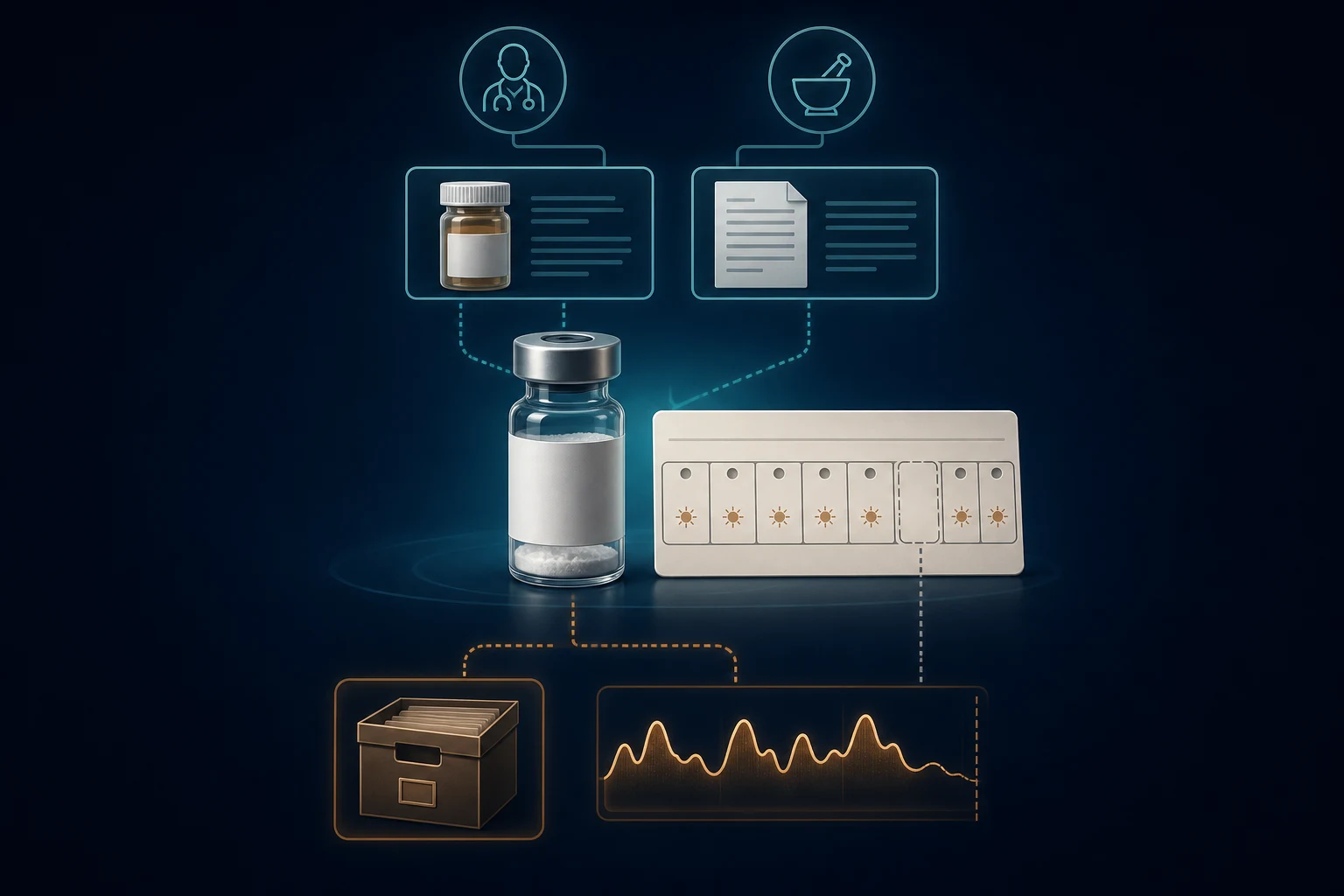
Sermorelin Missed Dose: Why the Dispensed Instructions Control
At a glance
- Currently marketed FDA-approved sermorelin product / none identified in the current Orange Book
- Historical products / Geref Diagnostic and Geref Pediatric, both discontinued
- Universal missed-dose rule / not established
- “Skip and resume tomorrow” evidence / not identified for modern compounded products
- “Never double” product-label instruction / depends on the actual dispensed directions
- Best source / pharmacy label, prescription, or prescriber's written plan for that product
- Possible duplicate or unexpected symptoms / contact a pharmacist, prescriber, or Poison Control for case-specific advice
- Medical review / current review of this revision is pending
The Missing Instruction Cannot Be Invented From Physiology
FDA states of compounded medicines:
“Compounded drugs are not FDA-approved. This means that FDA does not verify the safety, effectiveness or quality of compounded drugs before they are marketed.”
The issuer is the U.S. Food and Drug Administration. This 24-word passage explains why an old approved-product record cannot automatically validate the strength, stability, administration schedule, or missed-dose rule for a present compounded vial. It does not say every compounded product is defective or imply FDA endorsement of any alternative (FDA, “Are compounded drugs approved by FDA?”).
Sermorelin stimulates growth-hormone release, but mechanism does not answer whether a late dose should be taken, skipped, shifted, or withheld. That decision also depends on the prescribed frequency, the dispensed concentration, the actual administration time, other medicines, and whether a dose may already have been taken.
The Instruction-Provenance Ladder
| Source | What it can establish | What it cannot establish |
|---|---|---|
| Dispensing label and patient-specific prescription | The intended amount, frequency, route, storage, and any missed-dose instruction for the actual product | Whether an undocumented deviation is safe |
| Prescriber or dispensing pharmacist | Case-specific advice using the prescription and product record | A universal rule for every compounded formulation |
| Historical Geref labeling and trials | Prior approved diagnostic and pediatric uses of sermorelin and the studied regimens | Current compounded-product identity, potency, or catch-up instructions |
| GH/GHRH physiology | Why sermorelin can provoke GH release | A validated late-dose window or double-dose outcome |
| Seller protocol or forum post | What that seller or author recommends | Independent evidence that the instruction is safe or transferable |
The practical order is therefore simple: check the actual label first. If it is silent, ask the dispensing pharmacist or prescriber. Do not reconstruct a dose from a generic web page.
Figure 1
A missed or doubled sermorelin dose: whose instruction applies

Text version of this diagram
- No current FDA label to fall back on: FDA withdrew approval of both Geref sermorelin products effective June 18, 2009. Compounded sermorelin is not FDA-approved, and FDA does not verify it before it is marketed.
- Do the dispensing label or written prescription give a missed-dose instruction?
- Yes: Follow it for this product.
- No, or unclear: Contact the dispensing pharmacist or prescriber before taking more.
- Could a dose have been taken twice, or are there unexpected symptoms?
- Yes: Record product, concentration, amount, time and symptoms, then get case-specific advice before any further dose.
- No: Follow the label instruction or the answer you were given, and ask for any spoken answer in writing.
- What the historical trial shows: The Geref pediatric trial gave sermorelin once daily at bedtime for up to 1 year. Its abstract reports no missed-dose, late-dose or catch-up comparison.
What the Historical Record Actually Shows
FDA records distinguish two former products. Geref Diagnostic was approved as a single-dose test of pituitary growth-hormone reserve, while Geref Pediatric was approved for treatment of growth failure in children with growth-hormone deficiency. FDA's current Orange Book lists the relevant Geref applications as discontinued and marks them as not discontinued or withdrawn for safety or effectiveness reasons. A later FDA review states that the same GHRH(1–29) formulation had been used for the diagnostic and pediatric products, but with different purposes and dosing contexts (FDA EGRIFTA medical review, section 2.4).
The multicenter pediatric study used once-daily bedtime dosing for up to one year in previously untreated prepubertal children with GH deficiency. That supports the existence of a studied historical schedule; its abstract does not report a missed-dose comparison, a late-dose arm, or a catch-up rule (PMID 8772599).
The distinction matters. “A dose was historically given at bedtime” is not the same claim as “taking a late dose is unsafe,” “one missed dose is clinically trivial,” or “resume the following night.”
Figure 2
Geref, the FDA-approved sermorelin: approval, discontinuation and withdrawal dates
Show the numbers behind this chart
| Geref product | From (year) | To (year) | What applies |
|---|---|---|---|
| Geref diagnostic injection (NDA 19-863), pituitary growth hormone test | 1990 | 2009 | approved 1990, withdrawn 2009 |
| Geref pediatric injection (NDA 20-443), growth failure in GH-deficient children | 1997 | 2009 | approved 1997, withdrawn 2009 |
| Marker | 2008 | maker discontinues both (2008) | |
| Marker | 2013 | FDA: not withdrawn for safety or effectiveness (2013) |
A Missed-Dose Decision Record
Before requesting advice, capture the fields that actually change the answer:
- Exact pharmacy and product name.
- Concentration on the vial and amount on the dispensing label.
- Prescribed frequency and usual administration time.
- When the last confirmed dose was taken.
- Whether the dose was definitely missed or may have been duplicated.
- Current symptoms and relevant medicines or medical conditions.
- Storage history if the product was left unrefrigerated or otherwise mishandled.
This is more useful than quoting a short plasma half-life. A half-life does not identify the compounded product, prove what amount entered the body, or establish an evidence-based replacement window.
Missed-Dose Rules the Evidence Does Not Support
Missed-dose advice for sermorelin sometimes includes a universal “skip and resume at bedtime” rule, a typical dose and empty-stomach window, claims that a missed night is trivial, predictions of when IGF-1 will fall, and travel and refrigeration cutoffs. It may also invoke receptor desensitization and somatostatin feedback to warn against a double dose.
No cited study directly tested those missed-dose outcomes in the products now dispensed as compounded sermorelin. Some statements may resemble reasonable clinical habits, but a habit is not a product-specific evidence base.
The food and supplement evidence map applies the same distinction to meal and supplement claims. The nutrition audit separates human glucose-challenge physiology from a fasting protocol, and the storage and stability review addresses a different product-quality question.
The Responsible Current Answer
If the written instructions clearly address a missed dose, follow them. If they do not, or if a duplicate dose may have occurred, contact the dispensing pharmacist or prescriber before taking more. For a possible overdose or unexpected symptoms in the United States, Poison Control can provide case-specific triage at 1-800-222-1222; call 911 for collapse, seizure, trouble breathing, or inability to awaken.
This page cannot determine whether a dose was delivered, clear a possible dosing error, or replace the product-specific instructions.
Medical review of this revision is pending. FDA, sponsors, investigators, institutions, pharmacists, clinicians, and authors do not endorse sermorelin, HealthRX.com, or this page.
Frequently asked questions
What should I do if I miss compounded sermorelin?
Should I automatically skip the dose until tomorrow night?
Can an old Geref schedule answer the question?
What if I might have taken two doses?
References
- U.S. Food and Drug Administration. Compounding and the FDA: Questions and Answers. Current webpage accessed August 30, 2026. Quoted passage: “Are compounded drugs approved by FDA?”, first two sentences. https://www.fda.gov/drugs/human-drug-compounding/compounding-and-fda-questions-and-answers
- U.S. Food and Drug Administration. Approved Drug Products with Therapeutic Equivalence Evaluations (Orange Book), 46th Edition. 2026. Geref/sermorelin acetate entries for NDA 019863 and NDA 020443. https://www.fda.gov/media/71474/download
- U.S. Food and Drug Administration. EGRIFTA (tesamorelin) Medical Review. 2010. Section 2.4, “Important Safety Issues With Consideration to Related Drugs,” PDF pages 17–18. https://www.accessdata.fda.gov/drugsatfda_docs/nda/2010/022505Orig1s000MedR.pdf
- Thorner M; Rochiccioli P; Colle M; Lanes R; Grunt J; Galazka A; Landy H; Eengrand P; Shah S. Once daily subcutaneous growth hormone-releasing hormone therapy accelerates growth in growth hormone-deficient children during the first year of therapy. Geref International Study Group. The Journal of clinical endocrinology and metabolism. 1996 Mar;81(3):1189-96. DOI 10.1210/jcem.81.3.8772599. PMID 8772599. https://pubmed.ncbi.nlm.nih.gov/8772599/
- U.S. Food and Drug Administration, Federal Register. Determination That GEREF (Sermorelin Acetate) Injection, 0.5 Milligrams Base/Vial and 1.0 Milligrams Base/Vial, and GEREF (Sermorelin Acetate) Injection, 0.05 Milligrams Base/Amp, Were Not Withdrawn From Sale for Reasons of Safety or Effectiveness. Accessed 2026-10-18.
- National Capital Poison Center. First aid: Act fast! | Poison Control. Accessed 2026-10-18.