Ozempic nausea: meals, drinks and a useful symptom record
At a glance
- Nausea on 1 mg / 20.3% vs 6.1% on placebo [1]
- Nausea on 0.5 mg / 15.8% [1]
- When it clusters / most reports during dose escalation [1]
- Stopped for GI side effects / 3.8% on 1 mg, 0.4% on placebo [1]
- Meal pattern / 6 to 8 small meals instead of 3 large [2]
- Fluids / 8 to 10 cups of clear liquid a day [2]
- MedlinePlus reasons to seek care / no food or fluid kept down, vomiting 3 or more times a day, nausea over 48 hours [2]
- Kidney risk / label advises renal monitoring when vomiting or diarrhea causes fluid loss [1]
How often nausea happens on Ozempic
In the label's pooled placebo-controlled trials in type 2 diabetes (262 people on placebo, 260 on 0.5 mg and 261 on 1 mg, average 32.9 weeks), nausea was reported by 6.1% on placebo, 15.8% on 0.5 mg and 20.3% on 1 mg [1]. Vomiting was reported by 2.3%, 5% and 9.2%; diarrhea by 1.9%, 8.5% and 8.8%; any gastrointestinal reaction by 15.3%, 32.7% and 36.4% [1]. Treatment was stopped for gastrointestinal reasons by 0.4% on placebo, 3.1% on 0.5 mg and 3.8% on 1 mg [1].
The label also notes that the majority of reports of nausea, vomiting and diarrhea occurred during dose escalation [1].
Meals: smaller, blander, and sitting up afterwards
MedlinePlus's general self-care for nausea and vomiting suggests 6 to 8 small meals across the day instead of 3 large ones, built around bland foods such as crackers, English muffins, toast, baked chicken or fish, potatoes, noodles and rice [2]. Foods with a high water content, including clear soups, popsicles and Jell-O, are also on the list, and the advice is to avoid greasy and processed foods, very salty foods and very spicy foods; dairy may add to gas and diarrhea [2]. It also suggests sitting up after eating rather than lying down, and eating somewhere free of strong odors and distractions [2].
Drinks: how much, how cold, and what to skip
MedlinePlus advises 8 to 10 cups (2 to 2.5 liters) of clear liquid a day when you are nauseated, with cold water singled out as best, and suggests sipping fruit juice or flat soda and using sports drinks to replace minerals lost with vomiting [2]. Its avoid list for nausea includes caffeine, alcohol and carbonated drinks [2].
On Ozempic specifically, the fluid concern in the label is volume depletion. Postmarketing reports describe acute kidney injury, mostly in people who had gastrointestinal reactions leading to dehydration such as nausea, vomiting or diarrhea, and the label says renal function should be monitored in patients reporting reactions that could lead to volume depletion, especially during dose initiation and escalation [1].
Does the time of day you inject matter?
The label directs Ozempic once weekly, on the same day each week, at any time of day, with or without meals [1].
A symptom record
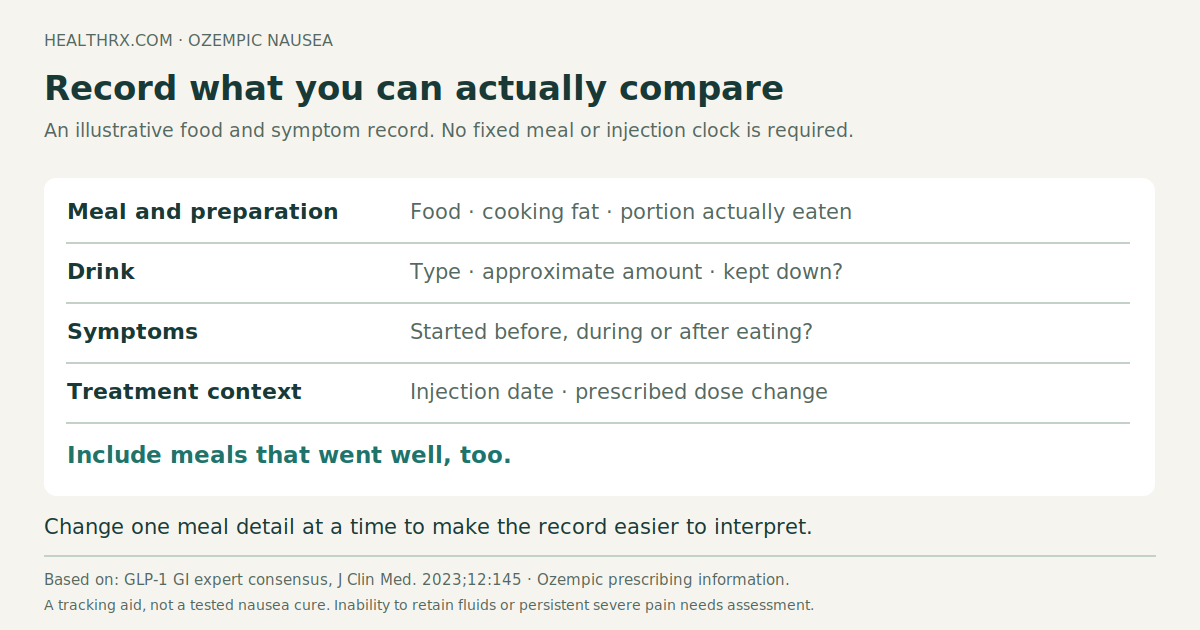
A record can list the food and how it was cooked, the amount actually eaten, the drink type and rough volume, when symptoms started relative to the meal, the injection day and any dose change, and whether fluids stayed down.
| Detail | What to write | Example entry |
|---|---|---|
| Portion | The amount actually eaten, not 'small meal' | Half my usual bowl of rice |
| Food and fat | The food and how it was cooked | Chicken baked with no oil |
| Pace and timing | When fullness or nausea started | Nausea began while eating |
| Drinks | Type and approximate volume | Half a glass of water |
| Dose context | Injection day and any dose change | Injected Tuesday, first week on 1 mg |
| Fluids kept down | Whether fluids stayed down | Kept water down, vomited once |
Is ginger worth trying?
The National Center for Complementary and Integrative Health reports that ginger has been studied for several kinds of nausea and vomiting and may be helpful for nausea in pregnancy; most studies of motion sickness have not shown benefit, and it is uncertain whether ginger helps with chemotherapy-related or post-surgical nausea [3]. Taken by mouth, ginger can cause abdominal discomfort, heartburn, diarrhea, and mouth and throat irritation, and NCCIH notes that some herbs and medicines interact in harmful ways [3].
When nausea needs medical attention
The Ozempic label says to watch for signs of acute pancreatitis, which can include persistent or severe abdominal pain, sometimes radiating to the back, and which may or may not be accompanied by nausea or vomiting; the label says to discontinue Ozempic if pancreatitis is suspected [1].
MedlinePlus lists these as reasons to seek care: being unable to keep any food or liquid down, vomiting three or more times in one day, nausea lasting more than 48 hours, weakness, fever, stomach pain, or not having urinated for 8 hours or more [2].
Frequently asked questions
How long does Ozempic nausea last?
How many meals does MedlinePlus suggest when you are nauseated?
Does the time of my injection relative to meals matter?
Which kinds of nausea has ginger been studied for?
Can I drink coffee while I feel nauseated?
Should I force a meal when I feel sick?
References
- U.S. National Library of Medicine, DailyMed. Ozempic injection (Novo Nordisk) prescribing information. Ozempic injection (Novo Nordisk) label
- When you have nausea and vomiting: MedlinePlus Medical Encyclopedia. When you have nausea and vomiting: MedlinePlus Medical Encyclopedia
- Ginger: Usefulness and Safety | NCCIH. Ginger: Usefulness and Safety | NCCIH