Persistent Testosterone Injection Pain: Describe the Change, Then Seek the Right Care
At a glance
- Listed reaction / Inflammation and pain at the intramuscular injection site (Depo-Testosterone) [1]
- Labeled route / Deep gluteal muscle, intramuscular only, never intravenous [1]
- Labeled dosing / 50 to 400 mg every 2 to 4 weeks [1]
- Vial contents / Cottonseed oil, benzyl benzoate, benzyl alcohol preservative [1]
- Cellulitis symptoms / Growing redness, warm skin, tenderness, swelling, drainage, fever, chills [2]
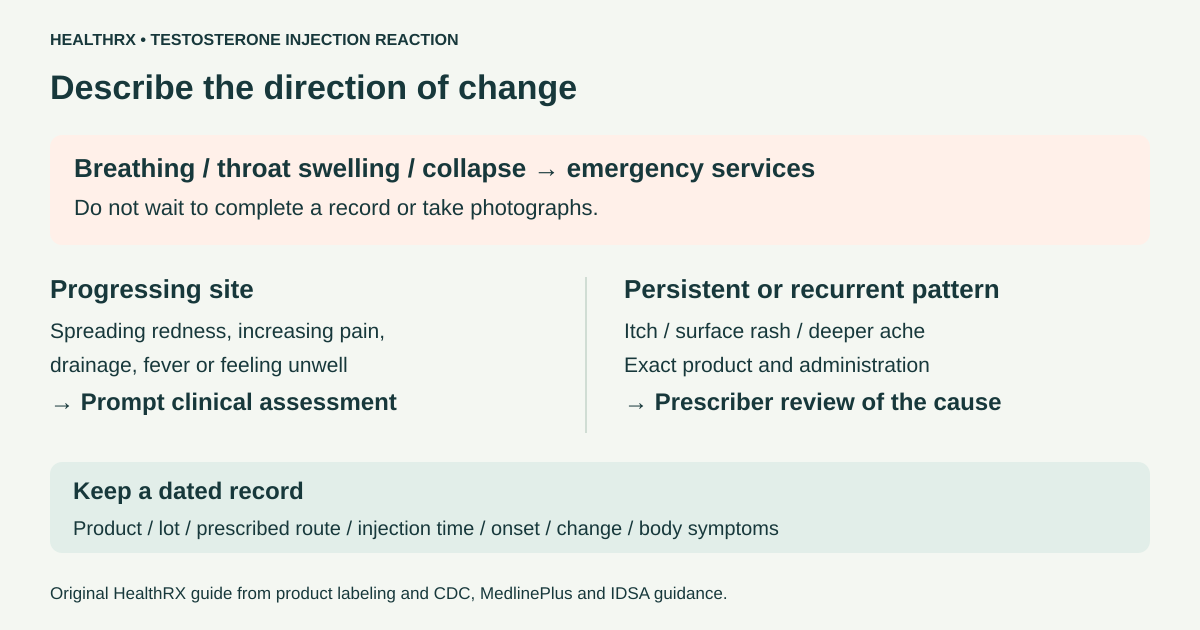
- Away from the site / The label says to evaluate leg pain, edema, warmth and redness for DVT, and acute breathlessness for PE [1]
What the cypionate label says about site pain
Depo-Testosterone's adverse reactions section lists inflammation and pain at the site of intramuscular injection among reactions reported with androgens, in the same list as gynecomastia, polycythemia and venous thromboembolism [1].
Depo-Testosterone is for intramuscular use only, given deep in the gluteal muscle, never intravenously, at 50 to 400 mg every two to four weeks [1]. It comes in 100 mg/mL and 200 mg/mL strengths; both contain testosterone cypionate with benzyl benzoate, cottonseed oil, and benzyl alcohol as a preservative [1]. Known hypersensitivity to the drug is a contraindication [1], and the label's allergic reactions include hypersensitivity with skin manifestations and anaphylactoid reactions [1]. The label does not name any ingredient as the cause of injection-site pain.
Signs that point away from a passing sore spot
MedlinePlus describes cellulitis as a bacterial infection of the middle layer of skin and the tissue below it, with symptoms including fever with chills and sweating, fatigue, pain or tenderness in the affected area, redness or inflammation that gets bigger as the infection spreads, tight glossy stretched skin, warm skin over the red area, and nausea and vomiting [2]. It lists drainage as a possible finding if pus builds up [2]. For someone already being treated for cellulitis, it lists persistent fever, drowsiness, lethargy, blistering over the area and spreading red streaks as new symptoms needing prompt medical contact [2].
MedlinePlus describes the assessment as starting with a physical exam, where a provider may find redness, warmth, tenderness, swelling, possible drainage and swollen lymph nodes nearby, and may mark the edge of the redness with a pen to see whether it crosses the line over the following days [2].
Symptoms away from the injection site
The label tells prescribers to evaluate patients who report pain, edema, warmth and erythema in the lower extremity for deep vein thrombosis, and those with acute shortness of breath for pulmonary embolism [1]. Venous thromboembolism and injection-site pain appear as separate entries in the label's adverse reactions list [1].
Recording the injection so the pattern is visible
- Exact product as printed on the vial (Depo-Testosterone, another cypionate brand, or a generic), plus strength (100 or 200 mg/mL) and lot number if visible [1].
- Date and time, which side, and who gave the injection. The labeled route is deep gluteal muscle [1].
- Needle length and gauge as printed on the packaging, and any difference from what was prescribed or taught.
- Symptom onset, then dated entries: better, same or worse; itch or surface rash versus deep ache; the measured size of any redness [2].
- Fever, chills, sweating and fatigue, which MedlinePlus lists as cellulitis symptoms [2], recorded separately from acute breathlessness, which the Depo-Testosterone label ties to evaluation for pulmonary embolism [1].
- Medicines taken and anything that changed between injections, such as a new vial, new supplies or a different injection site.
What a change of route can and cannot tell you
A crossover pilot by Wilson and colleagues put 14 adult transgender men on intramuscular testosterone for 3 weeks and then subcutaneous injections for 8 weeks. Total testosterone exposure was comparable between routes, and weekly questionnaires gave lower self-reported scores for pre-injection anxiety, pain during injection and post-injection pain on the subcutaneous route [3]. A separate retrospective study by Spratt and colleagues followed 63 transgender patients on weekly subcutaneous cypionate or enanthate at 50 to 150 mg, and reported minor, transient local reactions in 9 of 63; all 22 participants who had previously injected intramuscularly preferred subcutaneous injections, and none preferred intramuscular [4].
Only the pilot compared pain scores directly, and it was small. Both studies were in transgender adults on gender-affirming therapy, not in men with hypogonadism and persistent site pain [3][4]. The Depo-Testosterone label's route remains deep gluteal intramuscular [1].
Frequently asked questions
How long does testosterone cypionate injection-site pain last?
What does an infected injection site look like?
Could the cottonseed oil or benzyl alcohol be the cause?
Is subcutaneous injection an alternative?
When are leg swelling or breathlessness a separate concern?
References
- U.S. National Library of Medicine, DailyMed. Depo-Testosterone (cypionate) intramuscular, Pharmacia & Upjohn/Pfizer (testosterone cypionate) prescribing information. Depo-Testosterone (cypionate) intramuscular, Pharmacia & Upjohn/Pfizer (testosterone cypionate) label
- Cellulitis: MedlinePlus Medical Encyclopedia. Cellulitis: MedlinePlus Medical Encyclopedia
- Wilson DM, Kiang TKL, Ensom MHH. Pharmacokinetics, safety, and patient acceptability of subcutaneous versus intramuscular testosterone injection for gender-affirming therapy: A pilot study. Am J Health Syst Pharm. 2018;75(6):351-358. Pharmacokinetics, safety, and patient acceptability of subcutaneous versus intramuscular testosterone injection for gender-affirming therapy: A pilot study
- Spratt DI, Stewart II, Savage C, Craig W, Spack NP, Chandler DW, et al. Subcutaneous Injection of Testosterone Is an Effective and Preferred Alternative to Intramuscular Injection: Demonstration in Female-to-Male Transgender Patients. J Clin Endocrinol Metab. 2017;102(7):2349-2355. Subcutaneous Injection of Testosterone Is an Effective and Preferred Alternative to Intramuscular Injection: Demonstration in Female-to-Male Transgender Patients