Storing Spironolactone: Read the Label for Your Exact Product
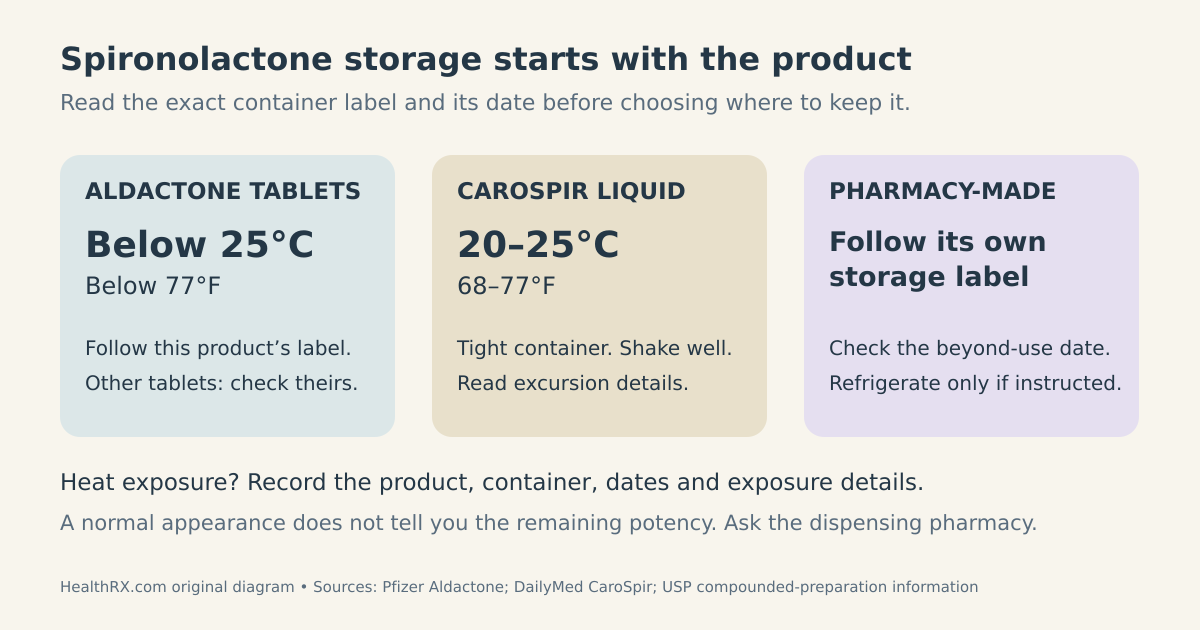
Spironolactone storage instructions depend on the product you have. Aldactone tablets, generic tablets, CaroSpir oral suspension, and pharmacy-made preparations should not be treated as though they share one storage rule or shelf life.
Start with the name and dosage form on your bottle, then read its storage instructions and expiration or beyond-use date. If the instructions are missing or unclear, the dispensing pharmacy can identify the requirements for your prescription. [1–4]
Match the instructions to your product
A labeled storage temperature describes how to keep the product. It does not supply an expiration date or a guaranteed duration after a storage problem.
| Product | Storage instructions | Which date to follow |
|---|---|---|
| Aldactone tablets | The manufacturer specifies storage below 25°C (77°F). | Follow the expiration or use-by information supplied for your dispensed medicine. [1] |
| Generic spironolactone tablets | Read that manufacturer’s and pharmacy’s label; do not assume every generic has identical wording. Keep the container closed and away from excess heat and moisture. | Follow the date on your dispensed container; clarify conflicting dates with the pharmacy. [3,4] |
| CaroSpir commercial oral suspension | Store at 20–25°C (68–77°F); labeled excursions are permitted to 15–30°C (59–86°F). Keep in a tight container and shake well. | Follow the labeled expiration information. The excursion range does not establish a guaranteed safe duration for a particular exposure. [2] |
| Pharmacy-made oral or topical spironolactone | Follow the compounding pharmacy’s instructions for that specific liquid, cream, or gel, including whether refrigeration is required. | Follow its assigned beyond-use date (BUD); do not substitute a research study’s testing period. [7,9] |
CaroSpir is a commercial suspension, not another name for every compounded spironolactone liquid. Its storage instructions should not be transferred to a pharmacy-made preparation, or vice versa. [2]
Make sense of the dates
A manufacturer’s expiration date applies to a product stored under its specified conditions. It is not a promise that medicine remains suitable after improper storage. FDA advises against using medicines after their expiration date. [4]
The date a prescription was filled identifies when it was dispensed; it is not necessarily its expiration date. A pharmacy may also provide a use-by date on the dispensing label. If you see several dates and cannot tell which controls use, ask the pharmacy rather than calculating a new date yourself.
A compounded preparation has an assigned BUD. That date belongs to the particular preparation supplied by the pharmacy. The usable period depends on the formulation, packaging and storage conditions; do not assign every suspension or topical product the same lifespan. [9] A manufacture date, dispensing date, expiration date, and BUD are not interchangeable.
Choose a suitable place at home
For tablets, use the original dispensing container with its lid closed, away from excess heat and moisture. A dry drawer or cabinet away from heat sources is generally more suitable than a steamy bathroom or a windowsill. Keep medicine out of children’s reach. [3]
Refrigeration is not a universal spironolactone requirement. CaroSpir has room-temperature instructions. For a compounded oral or topical preparation, follow the storage instructions supplied by its pharmacy. Do not move it into colder storage in an attempt to extend its date. [2,9]
Before transferring tablets into an organizer, ask whether that packaging is suitable for your particular product and circumstances. Keep the labeled bottle for product identification and storage instructions. An organizer’s suitability depends on the medicine and the conditions in which it will be kept. [5]
After a hot mailbox, car, or other storage problem
Heat exposure can affect medicine quality, but the setting alone cannot tell you how much potency was lost. A normal-looking tablet does not establish that the exposure was harmless. FDA recommends checking with a pharmacist, healthcare professional, or manufacturer when medicine has been exposed to temperatures outside its recommended conditions. [5,6]
Give the dispensing pharmacy enough information to review the actual product and exposure. This contact record can be copied into a message; enter “unknown” where necessary rather than guessing:
- Product: name, manufacturer, tablet strength or liquid/topical concentration; prescription number and lot number if available.
- Container: original bottle, pharmacy vial, organizer, or other packaging; whether it stayed closed.
- Printed instructions: storage wording and expiration date or BUD; attach photographs of the label and container.
- Exposure: location, date, start and end times, and measured temperature if known. Distinguish a weather estimate from an actual container temperature.
- Condition afterward: any leaking, moisture, changed appearance, or unusual texture.
- Question: “Can this specific supply still be used, or does it need replacement?”
For travel, keep medicine in your carry-on and protect it from heat. Carry-on packing does not itself guarantee correct storage, so preserve any product-specific temperature requirements during the trip. [5]
What research and appearance can tell you
A 1989 study tested specific compounded spironolactone suspensions in defined containers and storage conditions for four weeks. Its findings concern those preparations under those conditions; they do not assign an expiration date to your bottle or establish instructions for every liquid or cream. [7]
Changed color, smell, or texture, sticking tablets, and cracked or unusually soft tablets warrant pharmacy review rather than continued use. Appearance cannot measure potency, and an unchanged appearance cannot settle a heat-exposure question. If a liquid no longer mixes as expected when used according to its label, have the pharmacy assess it. [5,6]
Frequently asked questions
How should I store spironolactone tablets at home?
What is the shelf life of spironolactone tablets?
Can I use spironolactone after the expiration date?
Does spironolactone need to be refrigerated?
How long does compounded spironolactone suspension last?
Will heat damage my spironolactone tablets?
How does spironolactone work for acne?
Can I put spironolactone in a weekly pill organizer?
What does degraded spironolactone look like?
Is spironolactone stable in compounded topical creams?
Does freezing extend spironolactone's shelf life?
Can I travel with spironolactone on an airplane?
References
- Pfizer: Aldactone prescribing information.
- DailyMed: CaroSpir oral suspension labeling.
- MedlinePlus: Spironolactone.
- FDA: Don’t Be Tempted to Use Expired Medicines.
- MedlinePlus: Storing your medicines.
- FDA: Safe Drug Use After a Natural Disaster.
- Mathur LK, Wickman A. Stability of extemporaneously compounded spironolactone suspensions. Am J Hosp Pharm. 1989;46(10):2040–2042.
- American Academy of Dermatology: Acne clinical guideline highlights.
- USP: Compounded Preparation Monographs.