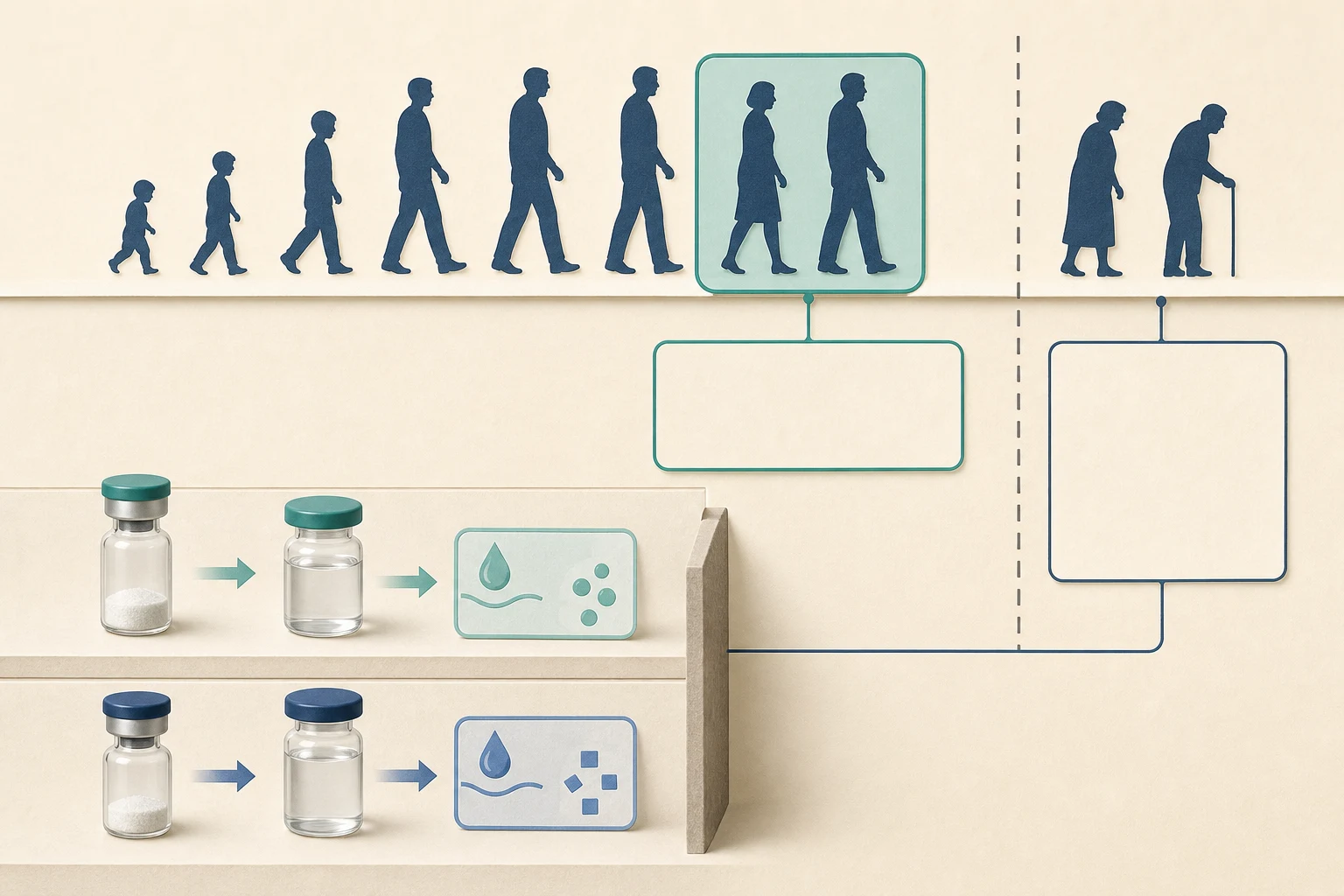
Tesamorelin Dosing at 50–64: Adult Label, Missing Subgroup
At a glance
- FDA-labeled population / adults with HIV and excess abdominal fat from lipodystrophy
- Pivotal trial age range / 18–65
- Mean age in both pivotal studies / 48
- Published age-50–64 dose comparison / not identified
- WR and SV / different strengths, preparation, storage, and labeled doses
- Formulation interchangeability / not substitutable
- Use information over age 65 / none in the label
- Medical review / current review of this revision is pending
“Adult” Is the Label Category; 50–64 Is an Evidence Question
The current EGRIFTA WR label states:
“There is no information on the use of EGRIFTA WR in patients greater than 65 years of age.”
The issuer is FDA through the approved prescribing information. The sentence defines a data gap above 65; it does not establish equal risk below 65, prohibit every older patient's use, or endorse EGRIFTA or HealthRX.com (label section 8.5, Geriatric Use).
A reader aged 50–64 is within the adult indication and within the pivotal studies' 18–65 eligibility range. That is not the same as a reported age-50–64 subgroup analysis.
Figure 1
Ages in the EGRIFTA pivotal trials: enrolled from 18 to 65, mean 48
Show the numbers behind this chart
| Trial measure | Low (years) | High (years) | Note |
|---|---|---|---|
| Main inclusion criterion, both pivotal trials | 18 | 65 | no label information on use above 65 |
| Study 1, mean age at baseline (412 randomized) | 48 | 48 | |
| Study 2, mean age at baseline (404 randomized) | 48 | 48 |
The Age-and-Formulation Extraction
| Evidence question | What the source reports | What remains unresolved |
|---|---|---|
| Were people 50–64 eligible? | Yes; pivotal studies enrolled ages 18–65 | Number exposed, dose response, and adverse events specifically at 50–64 |
| Was the cohort centered on young adults? | No; mean age was 48 in both studies | Distribution across later decades and statistical power by age |
| Does the label give an age-50–64 adjustment? | No separate age adjustment appears | Whether individual comorbidity or co-medication changes benefit-risk |
| What about age above 65? | Label says no use information | PK, efficacy, and safety in that population |
| Can WR and SV amounts be swapped? | No; the label says they are not substitutable | A conversion outside each product's instructions |
| Did a population PK model find age effects? | No clinically relevant covariate within a 38-person studied range | A dedicated older-adult PK or outcome study |
This is a claim audit, not a personal dose table.
The Formulation Difference Is Larger Than the Age Claim
The March 2025 label describes EGRIFTA WR as an 11.6 mg multi-dose vial with a labeled 1.28 mg daily injection. EGRIFTA SV uses a 2 mg single-dose vial and separate preparation and storage instructions. FDA explicitly says the two formulations and strengths are not substitutable (EGRIFTA WR section 2.1).
The legacy page presented a universal “2 mg once daily” answer and then added age-specific monitoring. That collapses product identity and age evidence into one number.
What the Adult Trials Actually Contribute
The two pivotal studies randomized 412 and 404 adults with HIV, lipodystrophy, and excess abdominal fat. Both reported a mean age of 48, defined metabolic exclusions, and used the earlier 2 mg formulation for 26 weeks, with extension follow-up (FDA label section 14; PMID 20554713).
A 38-person population PK analysis found no clinically relevant age covariate within the range studied. That supports its model, not a blanket conclusion that age never matters or that every comorbidity permits the same plan (PMID 25358450; DOI 10.1007/s40262-014-0202-x).
Label warnings still require patient-specific attention to active malignancy, pituitary-axis disruption, glucose status, persistent IGF-1 elevation, fluid retention, hypersensitivity, and interacting medicines. None becomes an age-50–64 protocol merely because prevalence may change with age.
Figure 2
EGRIFTA's neoplasm warning step by step, as the WR and SV labels set it out

Text version of this diagram
- Is there an active malignancy?
- Yes: Contraindicated: the labels say not to treat active malignancy with EGRIFTA. Any earlier malignancy must be inactive, with treatment complete, before starting.
- No: Go to the next question.
- Is there a history of a neoplasm?
- Treated, stable malignancy: Start only after careful evaluation of the benefit against the risk of the malignancy re-activating.
- Non-malignant neoplasm: Start after careful evaluation of the potential benefit.
- None: The labels still ask for careful thought because of the higher background risk of malignancies in HIV-positive patients.
- During treatment: Stop EGRIFTA if there is any evidence of recurrent malignancy.
- Why the labels are cautious: EGRIFTA releases the body's own growth hormone, which the labels call a known growth factor.
What a Real 50–64 Analysis Would Need
A decision-grade subgroup would report participants and exposure by age band, formulation, HIV regimen, baseline glucose status, malignancy history, kidney and liver function, discontinuations, adverse events, VAT response, and uncertainty around each estimate. The sources cited here do not publish that extraction.
The older-adult safety page examines the risk evidence without turning it into a dose. The renal-impairment review addresses another population with unestablished PK, and the levothyroxine interaction audit separates mechanism from documented adjustment.
The evidence-weighted conclusion is therefore narrow: follow the exact approved product's label within its indication; do not invent an age-50–64 change or infer certainty for people over 65.
Medical review of this revision is pending. FDA, NLM, sponsors, investigators, institutions, and authors do not endorse tesamorelin, HealthRX.com, or this page.
Frequently asked questions
Does tesamorelin have a special dose for ages 50 to 64?
Can EGRIFTA WR and EGRIFTA SV doses be converted directly?
What does the label say about patients over 65?
Did the pivotal trials include older adults?
References
- U.S. Food and Drug Administration. EGRIFTA WR (tesamorelin) Prescribing Information. Revised March 2025; Reference ID 5557578. Quoted passage: section 8.5, only sentence. See also sections 2.1, 5, 12.3, and 14. https://www.accessdata.fda.gov/drugsatfda_docs/label/2025/022505s020lbl.pdf
- Falutz J; Mamputu JC; Potvin D; Moyle G; Soulban G; Loughrey H; Marsolais C; Turner R; Grinspoon S. Effects of tesamorelin (TH9507), a growth hormone-releasing factor analog, in human immunodeficiency virus-infected patients with excess abdominal fat: a pooled analysis of two multicenter, double-blind placebo-controlled phase 3 trials with safety extension data. The Journal of clinical endocrinology and metabolism. 2010 Sep;95(9):4291-304. DOI 10.1210/jc.2010-0490. PMID 20554713. https://pubmed.ncbi.nlm.nih.gov/20554713/
- González-Sales M; Barrière O; Tremblay PO; Nekka F; Mamputu JC; Boudreault S; Tanguay M. Population pharmacokinetic analysis of tesamorelin in HIV-infected patients and healthy subjects. Clinical pharmacokinetics. 2015 Mar;54(3):285-94. DOI 10.1007/s40262-014-0202-x. PMID 25358450. https://pubmed.ncbi.nlm.nih.gov/25358450/
- Theratechnologies Inc., via DailyMed. EGRIFTA SV (tesamorelin) for injection, for subcutaneous use: prescribing information, patient information and instructions for use. SPL version 9, effective 2026-07-29.